2026-05-28 東北大学
東北大学の研究チームは、人間とAIが他者の身体動作から「敵か味方か」という社会的意図を認識する際に、大きな認識のズレ(アライメント・ギャップ)が存在することを明らかにした。研究では、日本人と台湾人俳優によるモーションキャプチャデータを用いて、人間と深層学習モデル(ST-GCN)の認識特性を比較した。その結果、大きく力強い高エネルギー動作による敵意表現は文化を超えて共有される一方、微細な低エネルギー動作による敵意表現は同一文化圏でのみ理解されやすく、「文化的方言」のように機能することが分かった。また、AIは動作パターン自体の分類精度は高いものの、人間が社会的意図を推論する際の認知過程とは大きく異なる判断を行っていた。研究チームは、本成果が人間とAI・ロボットの安全な相互作用設計や、人間の社会認知に整合したAI開発に重要な指針を与えるとしている。
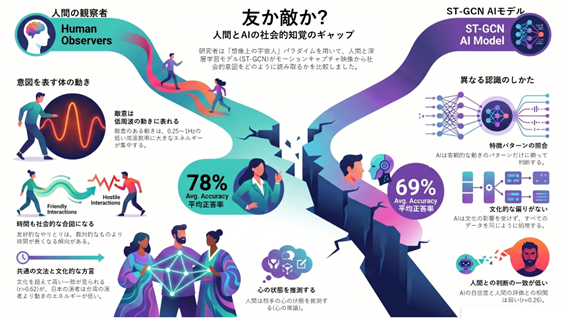
図1. 研究概要
<関連情報>
- https://www.tohoku.ac.jp/japanese/2026/05/press20260528-03-AI.html
- https://ieeexplore.ieee.org/document/11557029
味方か敵か? 身体化された社会的意図に対する人間の知覚とST-GCNによる解読のベンチマーク Friend or Foe? Benchmarking Human Perception and ST-GCN Decoding of Embodied Social Intention
Miao Cheng,Zhan Dai,Victor Schneider,Kanta Ozawa,Yangyang Cai,Ken Fujiwara,Yoshifumi Kitamura,Chia-huei Tseng
Proceedings of the 20th IEEE International Conference on Automatic Face and Gesture Recognition (FG 2026) Date Added to IEEE Xplore:17 June 2026
DOI:https://doi.org/10.1109/FG67764.2026.11557029
Abstract:
Distinguishing friendly from hostile intentions is a critical survival skill, particularly when verbal or facial cues are absent. While bodily emotion recognition is well-studied, the movement principles underlying “Friend vs. Foe” social intentions are under-explored. This paper presents a systematic study of embodied social intention from three perspectives: kinematic encoding, cross-cultural human expression and perception, and machine decoding. We constructed a novel motion capture database of 160 full-body recordings from 39 Taiwanese and 41 Japanese professional performers. An “imaginary alien” paradigm was used to elicit intention-driven movements while minimizing cultural stereotypes. Our analysis revealed a complex relationship between physical dynamics and social interpretation. Motion Energy Analysis (MEA) revealed that hostile intentions exhibit significantly higher energy concentrations in low-frequency bands than those in friendly intentional movements, with frequency-specific distinction between Japanese (0.25−1 Hz) and Taiwanese (0.5-1 Hz). Perceptual experiments with 77 observers from 3 cultural groups (Japanese, Taiwanese, Chinese) demonstrated robust cross-cultural consistency, with inter-group correlations exceeding rs>0.82. Qualitative analysis indicated that this human consensus relies heavily on inferring perceived mental states and movement dynamics. In contrast, a Spatio-Temporal Graph Convolutional Network (ST-GCN) achieved reliable classification accuracy but showed weak correspondence with human judgments (r=0.26). This discrepancy suggests that while current deep learning models can detect objective kinematic features of friendliness/hostility, they fail to capture the high-level cognitive inference strategies humans use to decode social intent. This work provides a challenging novel dataset and new insights into embodied social intention, and highlights key challenges for human-aligned social motion understanding.