2026-07-29 パデュー大学
<関連情報>
- https://www.purdue.edu/newsroom/2026/Q3/keys-to-future-human-exploration-past-planetary-conditions-hide-under-surface-of-moon-mars/
- https://www.nature.com/articles/s41550-020-01290-z
火星の北半球中緯度地域における地下水氷資源の存在可能性 Availability of subsurface water-ice resources in the northern mid-latitudes of Mars
G. A. Morgan,N. E. Putzig,M. R. Perry,H. G. Sizemore,A. M. Bramson,E. I. Petersen,Z. M. Bain,D. M. H. Baker,M. Mastrogiuseppe,R. H. Hoover,I. B. Smith,A. Pathare,C. M. Dundas & B. A. Campbell
Nature Astronomy Published:08 February 2021
DOI:https://doi.org/10.1038/s41550-020-01290-z
Abstract
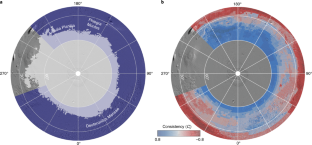
Multiple nations and private entities are pushing to make landing humans on Mars a reality. The majority of proposed mission architectures envision ‘living off the land’ by leveraging Martian water-ice deposits for fuel production and other purposes. Fortunately for mission designers, water ice exists on Mars in plentiful volumes. The challenge is isolating accessible ice deposits within regions that optimize other preferred landing-site conditions. Here we present the first results of the Mars Subsurface Water Ice Mapping (SWIM) project, which has the aim of searching for buried ice resources across the mid-latitudes. Through the integration of orbital datasets in concert with new data-processing techniques, the SWIM project assesses the likelihood of ice by quantifying the consistency of multiple, independent data sources with the presence of ice. Concentrating our efforts across the majority of the northern hemisphere, our composite ice-consistency maps indicate that the broad plains of Arcadia and the extensive glacial networks across Deuteronilus Mensae match the greatest number of remote-sensing criteria for accessible ice-rich, subsurface material situated equatorwards of the contemporary ice-stability zone.