2026-07-30 京都大学
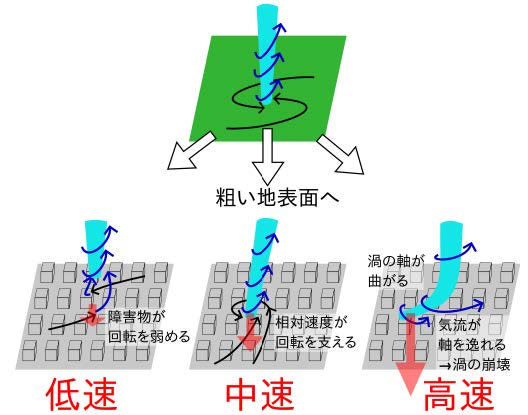
イラスト:佐藤宏樹
<関連情報>
- https://www.kyoto-u.ac.jp/ja/research-news/2026-07-30
- https://journals.ametsoc.org/view/journals/atsc/aop/JAS-D-25-0171.1/JAS-D-25-0171.1.xml
粗⾯に移動する⻯巻状渦に関する数値シミュレーション Numerical Simulations of Tornado-Like Vortices Translating toward Rough Surfaces
Hiroki Sato and Tetsuya Takemi
Journal of the Atmospheric Sciences Published:29 Jul 2026
DOI:https://doi.org/10.1175/JAS-D-25-0171.1
Abstract
To reveal the dynamic processes that a tornado experiences as it moves from a smooth to a rough surface, numerical experiments were performed. A vortex was generated in the upper part of the computation domain designed as a numerical Ward-type chamber. The motion of a tornado relative to the ground surface was represented by moving the lower part of the computational domain while keeping the upper part fixed. The translational speed and the arrangement pattern of roughness blocks were systematically varied. At a low translational speed, the vortex intensity showed almost stepwise changes, with a temporary transient intensification appearing in the cases with higher external swirl ratio. These changes are considered to be explained as a transition between steady-state conditions on smooth and rough surfaces. When the translation speed was moderate, vortex intensity was maintained even in roughness conditions where slowly translating vortices would be weakened. Trajectory analysis showed that the vortex was maintained by a supply of positive angular momentum from the low-level flow, where two relative velocity with respect to the vortex was influenced by the vortex translation. When a low-swirl vortex moved at a high speed onto a rough surface with densely distributed tall obstacles, the vortex structure distorted significantly, and finally the low-level vortex was weakened. On the other hand, the high-swirl vortex did not weaken significantly even when translating at the highest speed. This study suggests that the translational speed of tornadoes modulates the role of surface friction in maintaining or weakening tornadoes.