
2026-07-30 京都大学
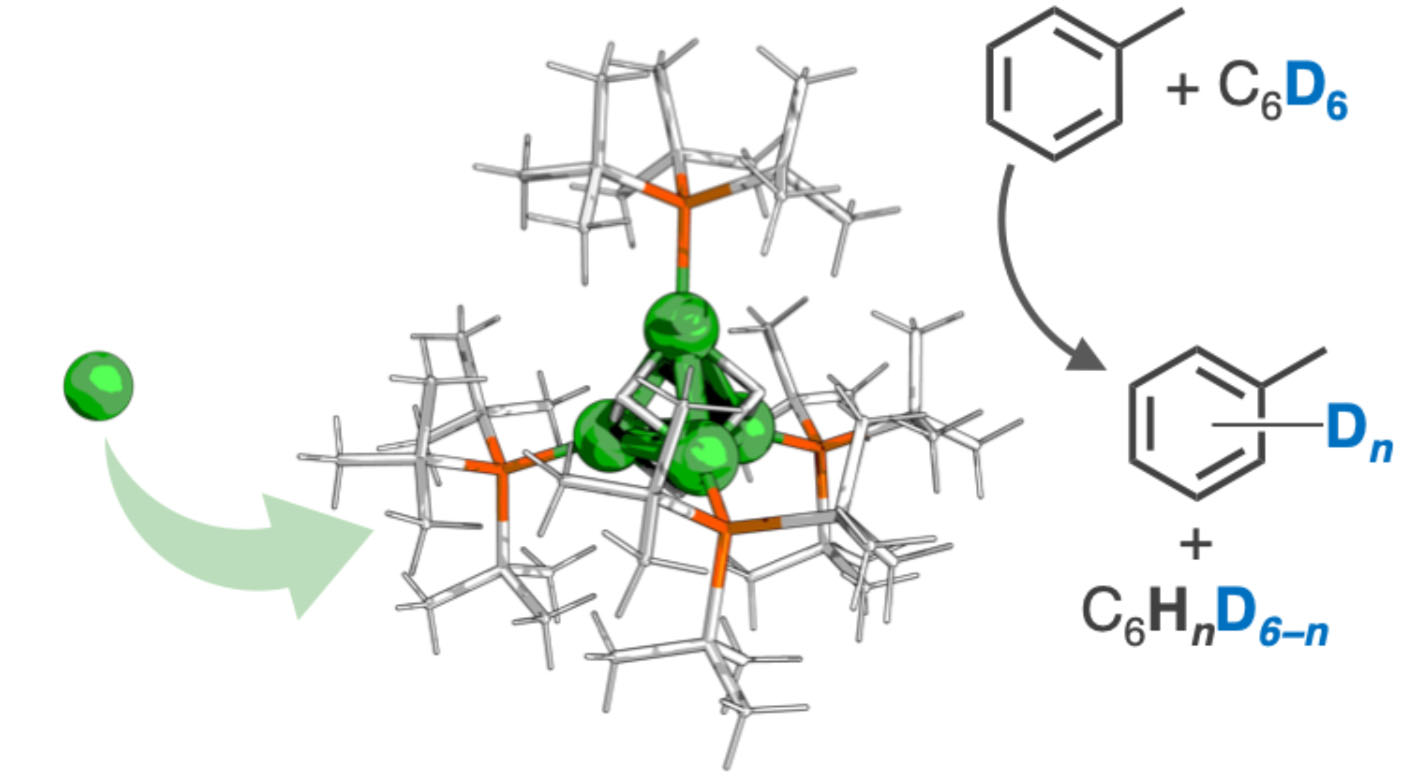
図: 4つのニッケル原子が協力して働くニッケルクラスター錯体による炭化水素C–H結合の活性化。図作成:伊豆仁助教(大木研究室)
<関連情報>
- https://www.kuicr.kyoto-u.ac.jp/sites/topics/260730/
- https://www.nature.com/articles/s41467-026-76006-4
芳香族および脂肪族C–H結合を可逆に活性化する四核ニッケルヒドリドクラスター A tetranuclear nickel hydride cluster capable of reversible activation of aromatic and aliphatic C–H bonds
Kohei Sunami,Tatsuya Higaki,Kanata Tanaka,Ryotaro Yamanashi,W. M. C. Sameera,Ryo Takahata,Toshiharu Teranishi,Soichi Kikkawa,Seiji Yamazoe,Takuya Shiga,Masayuki Nihei,Tatsuhisa Kato,Hitoshi Izu & Yasuhiro Ohki
Nature Communications Published:29 July 2026
DOI:https://doi.org/10.1038/s41467-026-76006-4
Abstract
Metal cluster complexes supported by multiple hydrides are useful for activating inert bonds and molecules, while nickel-based variants capable of activating external substrates remain scarce. Here, we report a tetranuclear Ni-hydride-phosphine cluster, [Ni4H4(PtBu3)4] (1), which we synthesize by reacting [Li(THF)x][Ni{N(SiMe3)2}3] (x ≈ 4.5 − 5) with pinacolborane (HBpin) in the presence of tri-tert-butylphosphine (PtBu3). Its molecular structure features a tetrahedral Ni4 core, with four face-capping μ3-hydrides and four terminally bound PtBu3 ligands. Cluster 1 is capable of reversible C–H and C–D bond cleavage of benzene-d6, toluene-d8, n-octane-d18, and its own PtBu3 ligands at 50 °C, leading to H/D exchange between the deuterated solvents and the ligands in 1. This reactivity is further utilized in the catalytic hydrogen isotope exchange reaction between benzene-d6 and toluene. The reversible dissociation of one PtBu3 ligand in 1 is proposed as the key step to trigger the C–H and C–D bond activation. Quantum chemical computations propose the reversible displacement of one of the PtBu3 ligands in 1 as the key step in triggering C–H and C–D bond activation.

](https://tiisys.com/wp-content/uploads/2026/07/スクリーンショット-2026-07-30-143157-500x612.png "匠航空ロビンソンR44Ⅱ(回転翼航空機)の事故[ハードランディングによる搭乗者の負傷](熊本県阿蘇市、令和6年5月13日発生)")