2026-07-29 東京大学

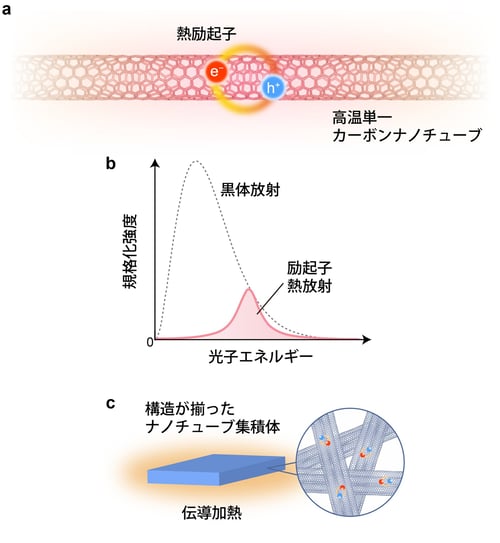
図1 カーボンナノチューブと励起子熱放射。クリエイティブ・コモンズ・ライセンス(表示4.0 国際)
<関連情報>
- https://www.t.u-tokyo.ac.jp/press/pr2026-07-29-001
- https://www.nature.com/articles/s41467-026-75711-4
カイラリティ分離カーボンナノチューブからなるマクロスケール膜からの励起子熱放射とその制御 Exciton thermal radiation from macroscale membranes composed of chirality-sorted carbon nanotubes and its control
Akiteru Takahashi,Mioko Hizukuri,Kaichi Teranishi,Shonosuke Takaichi,Taishi Nishihara & Yuhei Miyauchi
Nature Communications Published:29 July 2026
DOI:https://doi.org/10.1038/s41467-026-75711-4
Abstract
Exciton thermal radiation, which can potentially be exploited for selective thermal emission and energy harvesting, has been observed in individual single-walled carbon nanotubes (SWCNTs) heated under photoirradiation. However, whether macroscale-SWCNT assemblies can emit exciton thermal radiation under thermal conduction heating remains unclear and constitutes an important challenge for practical applications. Herein, we observe peaked exciton thermal radiation from chirality-sorted SWCNT membranes. Transmission spectroscopy shows robust exciton resonance at high temperatures, resulting in clear exciton resonance in the thermal radiation band. The absolute emissivity spectra of the membranes are determined at 850 K. Exciton dominance suppresses the contribution of thermal free carriers to the infrared absorption/emission spectra, maintaining the transparency below the optical gap even at elevated temperatures. Furthermore, we demonstrate the enhancement of emissivity at the exciton resonance using a simple planar few-layer architecture consisting of alternating SWCNT and transparent dielectric layers, enabled by strong excitonic light-matter interactions in SWCNTs; this offers a pathway toward superior spectral selectivity at even higher temperatures. These results highlight the potential of chirality-sorted SWCNT membranes as a class of semiconductors for controlling thermal radiation at elevated temperatures, leveraging thermo-optical properties that differ from those of conventional bulk semiconductors.