2026-07-02 京都⼤学
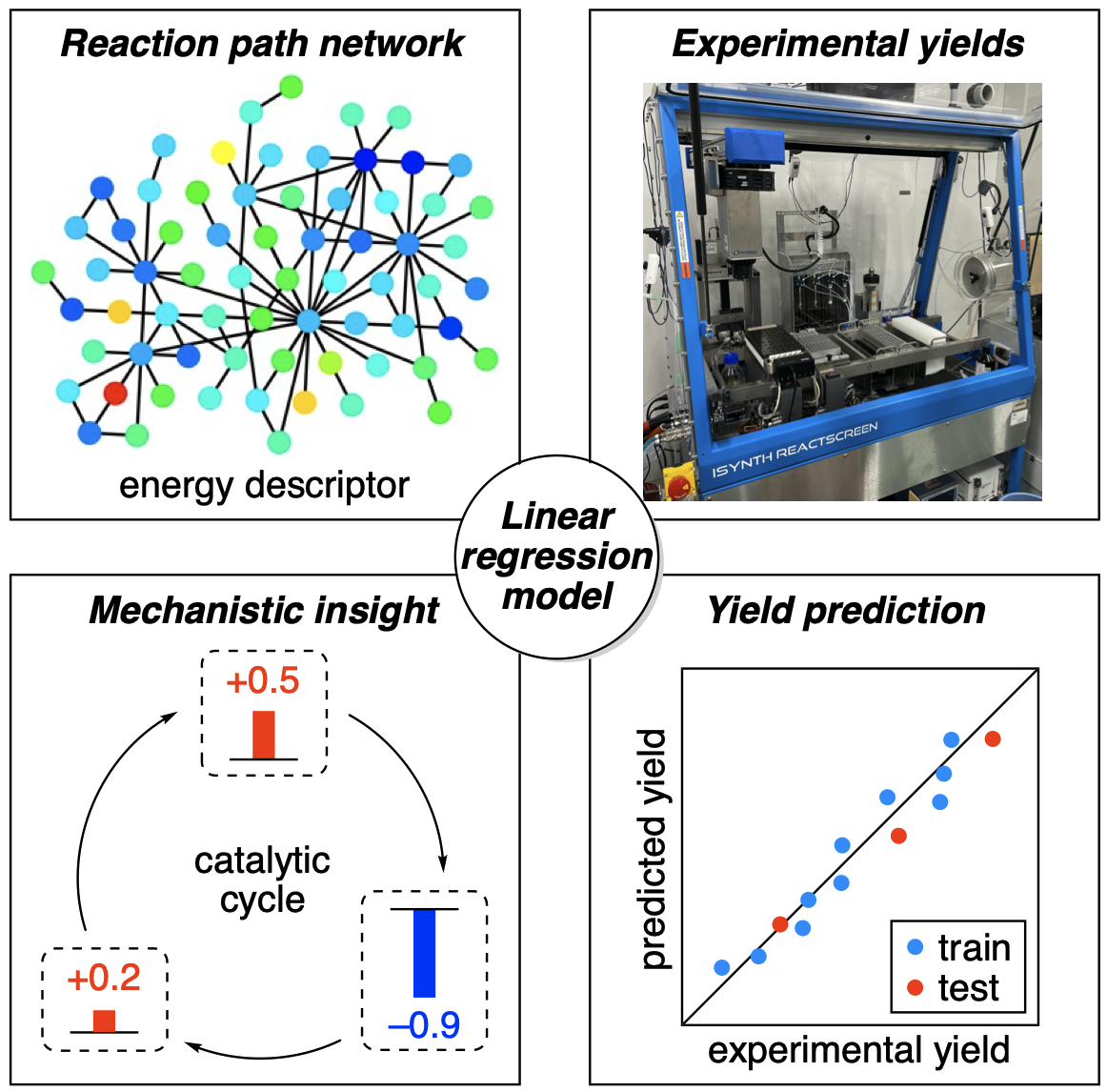
本研究の概要図:反応経路の自動探索で得た中間体のエネルギーを記述子とし、ロボット実験で得た収率と線形回帰でつなぐことで、収率予測と反応機構の解明を同時に実現する。(作成:道場 貴大)
<関連情報>
自動反応経路探索によって可能になった、収率予測と反応機構解明のための解釈可能な回帰モデルの構築 Construction of an Interpretable Regression Model for Yield Prediction and Mechanistic Insight Enabled by Automated Reaction Path Exploration
Takahiro DobaYu Harabuchi,Yuuya Nagata,and Satoshi Maeda
Journal of the American Chemical Society Published: June 19, 2026
DOI:https://doi.org/10.1021/jacs.6c05203
Abstract
In the past decade, machine learning has emerged as a powerful tool to predict reaction outcomes. However, mechanistic interpretability of the constructed machine learning models remains limited due to the use of domain-specific and often arbitrary descriptors. Herein we demonstrate that an energy descriptor comprising the energies of the possible intermediates in the reaction system serves as a physically motivated representation for constructing interpretable regression models that provide mechanistic insight. The energy descriptor was calculated using the single-component artificial force induced reaction (SC-AFIR) method, which autonomously and comprehensively searches for intermediates of a target reaction, and subsequently used to train regression models for reaction yield prediction. Linear models with regularization showed good predictions for the hold-out samples (RMSE < 7% yield) and the coefficients of the models provided information on how the energies of the intermediates relate to the reaction outcome. This work highlights the utility of energy descriptors in constructing mechanistically interpretable regression models for predictive tasks in chemistry.