2026-10-28 . 中国科学院(CAS)
中国科学院西双版納熱帯植物園(XTBG)の研究チームは、中国雲南省の熱帯林において、イノシシの生息密度が農作物への被害を増加させる一方、野生動物の多様性や生態系の安定性にも関係することを明らかにした。研究チームは、農作物被害の広域記録と、540地点に設置したカメラトラップによる中・大型陸生脊椎動物の調査データを組み合わせ、イノシシの生息数と他の動物の分布・行動との関係を分析した。その結果、イノシシが多い地域では、特にトウモロコシの農業被害が大きかった一方、確認される脊椎動物の種数が多く、種間の共存ネットワークも安定していた。イノシシは地面を掘り返したり泥浴び場を形成したりすることで微小な生息環境を生み、他の生物に利益をもたらす「生態系エンジニア」として機能している可能性がある。また、調査対象35種のうち21種でイノシシとの活動時間帯の違いが大きくなり、23種で一時的な回避行動が確認された。研究チームは、農作物被害だけを基準とする駆除では生物多様性を損なう恐れがあり、農地周辺の防護策と森林内の生態系機能を考慮した管理が必要だと指摘している。
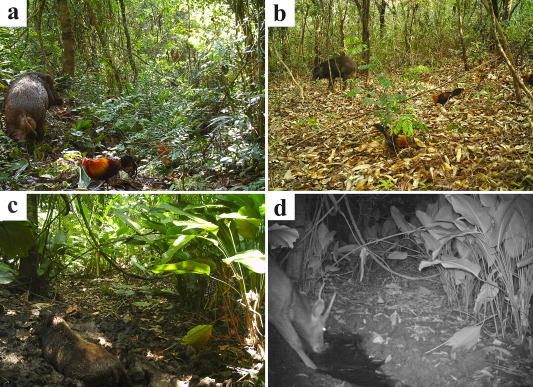
Camera-trap images illustrate potential facilitative interactions between sympatric vertebrates and wild boar.(Image by XTBG)
<関連情報>
論文タイトル
Beyond conflict in “overabundant” species management: Wild boar abundance is associated with increased crop damage, but also higher vertebrate richness and co-occurrence network stability
Ru-Chuan He,Christos Mammides,Lin Wang,Jia Zhou,Zhong-Yuan Li,Zhong-Li Gan,Rui-Chang Quan
Biological Conservation Available online: 29 September 2026
DOI:https://doi.org/10.1016/j.biocon.2026.112123
Highlights
- Wild boar abundance is associated with higher crop damage.
- However, it is also associated with higher vertebrate richness and network stability.
- Culling based solely on perceived conflict poses risks to vertebrate communities.
- Management must shift from conflict-driven to ecologically evidence-based strategies.
Abstract
Managing overabundant species that pose significant challenges to ecosystems and human societies is a critical global conservation issue. The wild boar (Sus scrofa) is widely recognized for causing severe human-wildlife conflict and economic losses. Management actions, such as population control, are often justified by perceived conflict intensity, based on the assumption that higher wild boar abundance equates to greater conflict and increased ecosystem degradation. In this study, we integrate large-scale crop-damage records with camera-trap surveys from 540 sites in Xishuangbanna, China, to test this assumption and evaluate the importance of local ecological context in guiding wild boar population management. While higher wild boar abundance was associated with increased crop damage, as expected, areas with high boar abundance showed predominantly positive associations with sympatric vertebrates and supported higher species richness and more stable co-occurrence networks compared to areas with lower boar abundance. Our findings suggest that, contrary to the assumption of predominantly negative ecological effects, culling measures based solely on perceived conflict intensity may pose unintended ecological risks, potentially compromising local species richness and the stability of co-occurrence networks. Effective management of overabundant species requires a paradigm shift from conflict-driven control to evidence-based ecological strategies that balance conflict mitigation with the maintenance of essential ecosystem functions.