
2026-10-05 ジョージア大学(UGA)
<関連情報>
- https://news.uga.edu/warmer-oceans-disease-put-coral-reefs-at-risk/
- https://link.springer.com/article/10.1007/s00338-026-02928-6
大規模な白化現象におけるサンゴの死亡率は、病変組織への近接性およびサンゴ礁の地形によって影響を受ける Coral mortality in a mass bleaching event influenced by proximity to diseased tissue and reef topography
Camilla L. Nivison, Christa R. May, Mari Ella Bourbonnais, Shannon Shotz, Isabelle Basden, Deyan Deng, Shannon Dixon, Debao Huang, Ann Marie Hulver, Mariam Ayad, Erin K. Lipp, Rongjun Qin, Andréa G. Grottoli & James W. Porter
Coral Reefs Published:20 July 2026
DOI:https://doi.org/10.1007/s00338-026-02928-6
Abstract
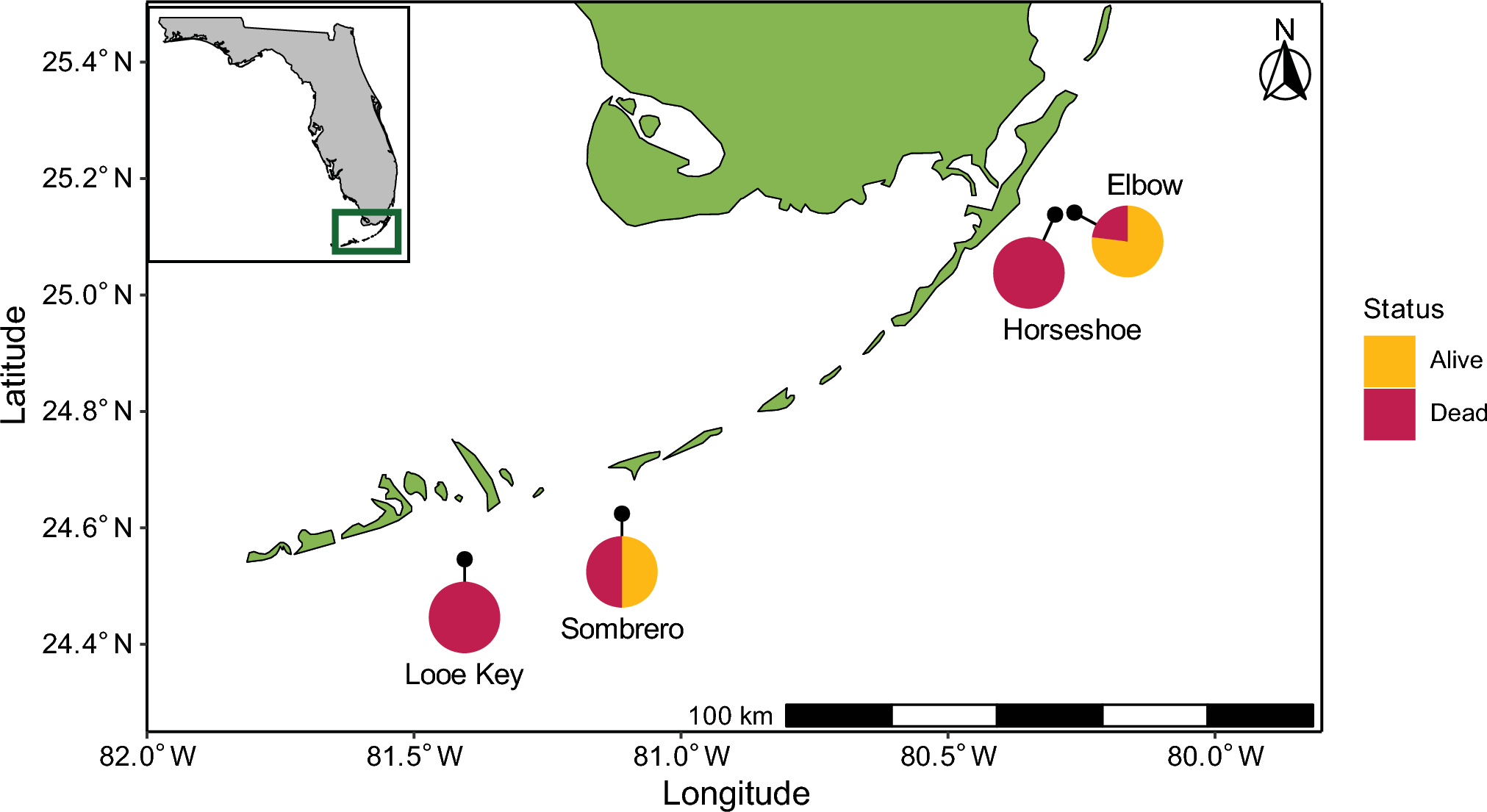
Coral reefs of the Florida Keys experienced the hottest summer on record in 2023, causing mass bleaching and mortality of scleractinian corals. Sea surface temperatures remained above 31°C for 41 days, exceeding all prior records for the region. Branching corals fared especially poorly, especially Acropora palmata, which has now been deemed functionally extinct across the entire Florida Reef Tract. High temperatures and prolonged thermal stress were the major causes of mortality. Our study investigates additional stressors contributing to coral mortality during the heatwave. Using benthic imagery, we show that during bleaching, coral tissue death is accelerated by proximity to disease. Using a Cox proportional hazard model, we found that, compared to initially healthy tissue on the same colony, disease lesions and neighboring tissue had a 3.8 times and 1.5 times higher risk of death, respectively. We show that these two stressors, working at different spatial scales, acted synergistically to increase mortality. Furthermore, from our in situ reef structural measurements, we found that during bleaching, coral survival was greatest along the reef edge. The reef displaces water, resulting in faster local velocity, which we hypothesize reduces the boundary layer at the tissue-water interface and thus simultaneously enhances the removal of cytotoxic metabolic wastes and the opportunity for coral heterotrophic feeding. Our findings reinforce the importance of the interactive effects of disease and reef topography on coral mortality, and suggest that restoration efforts should focus on reef edges where the chance of survival is improved relative to the reef interior.

