2026-10-06 パデュー大学
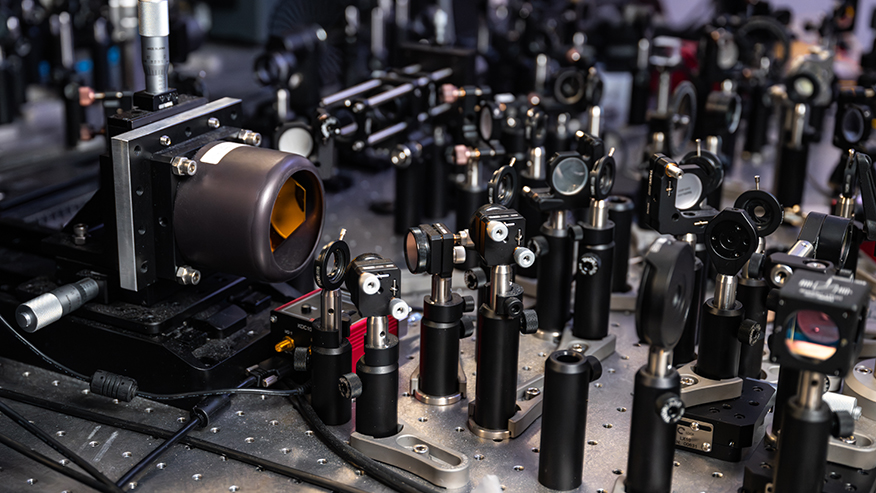
With a microscopy method that she developed, Libai Huang is able to see quantum particles moving through materials at a rate of up to 1 quadrillion (that’s 1,000,000,000,000,000) images per second, helping to establish the rules that advance computer chips, solar cells and LEDs, and quantum computing. (Purdue University photo/Kelsey Lefever)
<関連情報>
- https://www.purdue.edu/newsroom/2026/Q4/movies-of-interaction-between-light-and-matter-help-advance-quantum-tech/
- https://www.nature.com/articles/s41563-025-02135-8
- https://www.nature.com/articles/s41467-024-55812-8
モアレ超格子における励起子モット絶縁体の凍結された非平衡ダイナミクス Frozen non-equilibrium dynamics of exciton Mott insulators in moiré superlattices
Shibin Deng, Heonjoon Park, Jonas Reimann, Jonas M. Peterson, Daria D. Blach, Meng-Jia Sun, Tengfei Yan, Dewei Sun, Takashi Taniguchi, Kenji Watanabe, Xiaodong Xu, Dante M. Kennes & Libai Huang
Nature Materials Published:03 March 2025
DOI:https://doi.org/10.1038/s41563-025-02135-8
Abstract
Moiré superlattices, such as those formed from transition metal dichalcogenide heterostructures, have emerged as an exciting platform for exploring quantum many-body physics. They have the potential to serve as solid-state analogues to ultracold gases for quantum simulations. A key open question is the coherence and dynamics of the quantum phases arising from photoexcited moiré excitons, particularly amid dissipation. Here we use transient photoluminescence and ultrafast reflectance microscopy to image non-equilibrium exciton phase transitions. Counterintuitively, experimental results and theoretical simulations indicate that strong long-range dipolar repulsion freezes the motion of the Mott insulator phase for over 70 ns. In mixed electron–exciton lattices, reduced dipolar interactions lead to diminished freezing dynamics. These findings challenge the prevailing notion that repulsion disperses particles, whereas attraction binds them. The observed phenomenon of frozen dynamics due to strong repulsive interactions is characteristic of highly coherent systems, a feature previously realized exclusively in ultracold gases.
Environment-assisted quantum transport of excitons in perovskite nanocrystal superlattices
Daria D. Blach, Victoria A. Lumsargis-Roth, Chern Chuang, Daniel E. Clark, Shibin Deng, Olivia F. Williams, Christina W. Li, Jianshu Cao & Libai Huang
Nature Communications Published:02 February 2025
DOI:https://doi.org/10.1038/s41467-024-55812-8
Abstract
Transport of energy carriers in solid-state materials is determined by their wavefunctions and interactions with the environment. While quantum transport theory has predicted distinct transport in the intermediate coupling regime resulting from the intricate interplay between coherent wave-like and incoherent particle-like mechanisms, these predictions are awaiting experimental evidence. Here we demonstrate quantum transport signatures in perovskite nanocrystal superlattices by imaging exciton propagation with high spatial and temporal resolutions over 7-298 K. At 7 K, coherent propagation of the excitons dominates, with transient ballistic motion within a coherence length of up to 40 nanocrystal sites. The interference of the wave-like motion leads to Anderson Localization in the long-time limit. As temperature increases, a peak in the long-time diffusion constant is observed at a temperature where static disorder and dephasing are balanced, which substantiates evidence for environment-assisted quantum transport. Our results connect theoretical predictions and experiments using a stochastic Anderson localization model, highlighting perovskite nanocrystals as promising building blocks for quantum materials.