2025-09-05 中国科学院(CAS)
<関連情報>
- https://english.cas.cn/newsroom/research_news/phys/202509/t20250908_1054161.shtml
- https://iopscience.iop.org/article/10.3847/1538-4357/add728
パークス超広帯域受信機によるミリ秒パルサーB1937+21の周波数依存性放射 Frequency-dependent Emission of the Millisecond Pulsar B1937+21 with the Parkes Ultrawideband Receiver
Z. Wang, Z. G. Wen, J. P. Yuan, N. Wang, W. Han, H. G. Wang, J. L. Chen, and Z. Wang
The Astrophysical Journal Published: 2025 June 26
DOI:10.3847/1538-4357/add728
Abstract
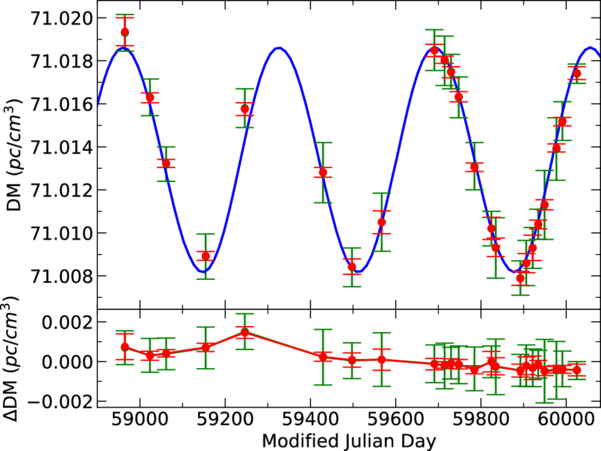
In this study, we report on the broadband polarization behavior of the millisecond pulsar B1937+21 (J1939+2134), using high-quality observations made with the ultrawideband low receiver on Murriyang, the Parkes radio telescope. Observations spanning approximately 3 yr are carefully calibrated and integrated to produce high-signal-to-noise-ratio pulse profiles. Updated and accurate interstellar medium parameters toward the pulsar are obtained. The temporal variability of the dispersion measure, the Faraday rotation measure, and the flux density are analyzed from their corresponding structure functions. The frequency-and-longitude-dependent polarization evolutions are investigated. The spectra of the mean flux density follow a high-frequency cutoff power law, with the interpulse spectra being steeper than the main pulse. The fractional linear polarization of the main pulse decreases with increasing frequency, while the interpulse presents the opposite trend. Both the main pulse and interpulse exhibit increasing absolute circular polarization with increasing frequency. The peak intensity ratio of the main pulse to the interpulse increases with frequency, following a power-law spectrum with an index of 0.52 ± 0.02. The pulse width decreases with increasing frequency, further confirming that the emission height decreases with frequency, consistent with the results obtained from relativistic effects. These findings will contribute to a deeper understanding of the underlying emission mechanisms.