2026-10-15 中国科学院(CAS)
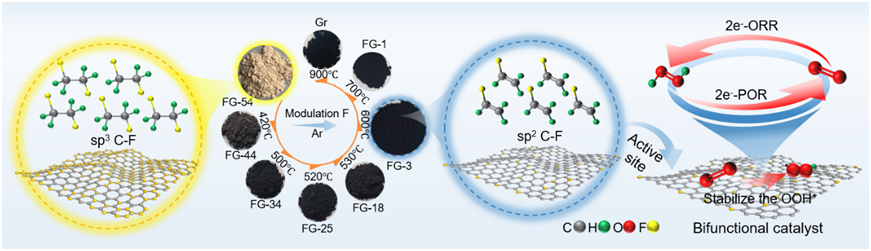
Schematic illustration of the thermal defluorination strategy for synthesizing fluorinated graphene and its application in bifunctional oxygen-peroxide electrocatalysis. (Image by Prof. WEN’s group)
<関連情報>
- https://english.cas.cn/newsroom/research-news/202610/t20261015_1203726.shtml
- https://onlinelibrary.wiley.com/doi/10.1002/anie.9423554
可逆的な酸素-過酸化水素電気触媒反応のための、カスタマイズされたsp2 – C─F結合 Tailored sp2-C─F Bonding for Reversible Oxygen-Peroxide Electrocatalysis
Peng Lin, Junxiang Chen, Shengjian Lin, Jun Wang, Nianxiang Hu, Wajahat Sajjad, Junheng Huang, Zhenhai Wen
Angewandte Chemie International Edition Published: 26 September 2026
DOI:https://doi.org/10.1002/anie.9423554
ABSTRACT
Rechargeable zinc-air batteries are fundamentally limited by the sluggishness of four-electron (4e−) oxygen electrocatalysis and by bifunctional catalysts that rarely combine high activity with long-term durability, resulting in substantial polarization and poor reversibility. Replacing this chemistry with O2–H2O2 interconversion offers a compelling alternative, because two-electron (2e−) oxygen electrocatalysis features intrinsically more reversible pathways and faster kinetics. Herein, fluorine-doped graphene is established as a programmable electrocatalytic platform for O2-H2O2 interconversion, where tailored sp2-C─F bonding acts as a precise electronic lever to regulate OOH* intermediate binding and thereby steer O2–H2O2 redox selectivity and kinetics. By controlling fluorine incorporation, the local electronic environment of graphene is delicately engineered without sacrificing electrical conductivity. The optimized catalyst exhibits outstanding bifunctional activity for 2e− oxygen reduction reaction (2e– -ORR) and peroxide oxidation reaction (POR), translating into rechargeable zinc-based batteries with high power output and robust long-term durability. Mechanistic studies reveal that sp2-C─F bonding induces localized electrostatic polarization at neighboring carbon sites, selectively stabilizing OOH* intermediates, lowering the kinetic barrier for 2e–-ORR, and concurrently facilitating POR while minimizing parasitic reactions. These findings demonstrate a fundamental structure-property principle linking fluorine-induced polarization with O2–H2O2 redox kinetics, and position fluorinated carbon frameworks as a versatile foundation for next-generation reversible energy storage.