2026-10-22 中国科学院(CAS)
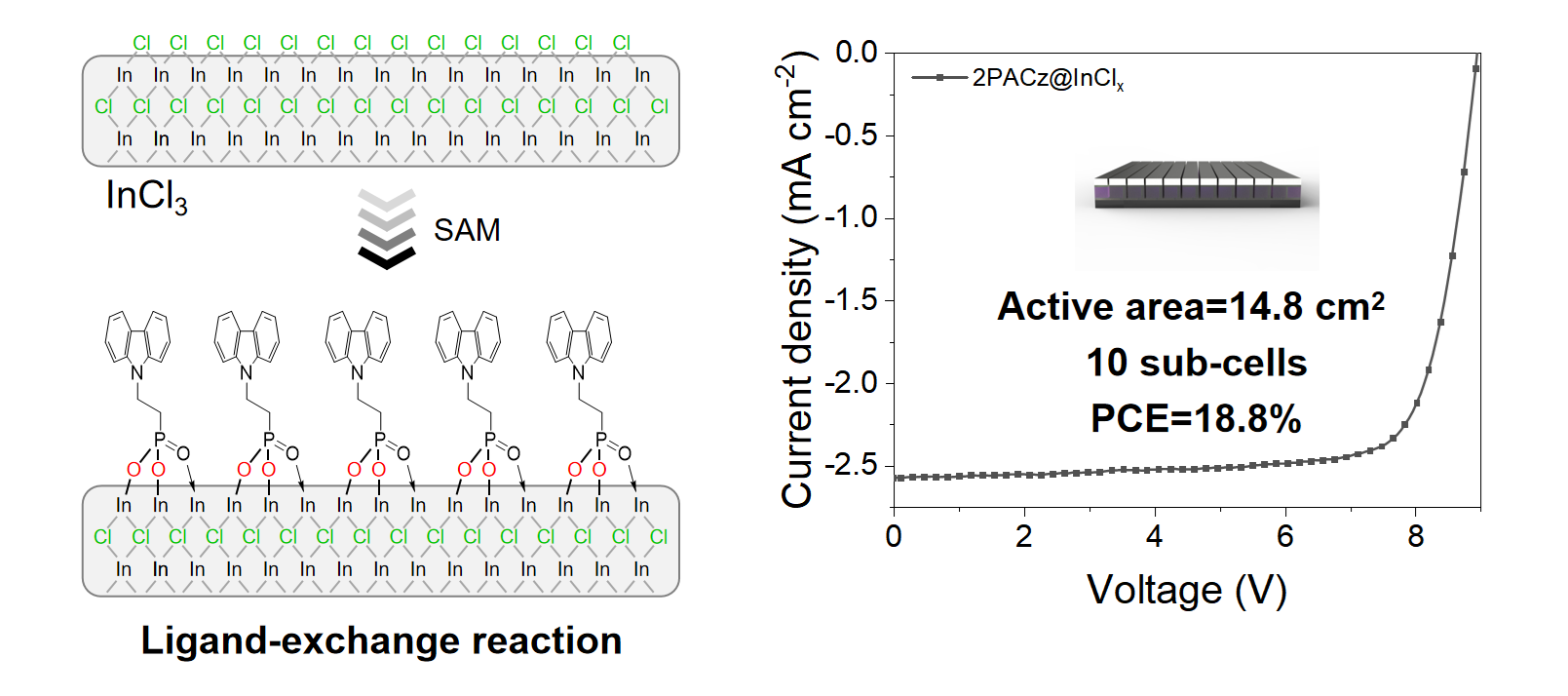
The interface diagram and performance of organic solar cells based on the molecular locking strategy (Image by NIMTE)
<関連情報>
- https://english.cas.cn/newsroom/research-news/202610/t20261020_1209200.shtml
- https://www.cell.com/joule/abstract/S2542-4351(26)00393-4
配位子交換反応による塩化物媒介SAMロックにより、18.8%の活性面積効率と安定した有機太陽電池モジュールが実現 Chloride-mediated SAM locking via ligand-exchange reaction enables 18.8% active-area efficiency and stable organic solar modules
Ze Jin ∙ Cheng Shen ∙ Quan Liu ∙ Ziyi Ge
Joule Published:October 21, 2026
DOI:https://doi.org/10.1016/j.joule.2026.102709
Highlights
- A molecular locking strategy for anchoring SAMs via a vacuum-deposited InClx interlayer
- The InClx interlayer drives ligand exchange to form a robust In–O–P network
- We achieved 20.4% small-area efficiency and 18.8% active-area module efficiency
- Devices retain >85% of initial PCE after 2,000 h under ISOS-L-1 conditions
Summary
The unstable interface between commercial indium tin oxide (ITO) and self-assembled monolayers limits the efficiency, stability, and scalability of organic solar cells (OSCs). Herein, we introduce a molecular locking strategy that re-engineers this interface using a vacuum-deposited InClx intermediate layer. Upon thermal annealing, a ligand-exchange reaction occurs where Cl− ions are displaced, driving the formation of a robust, multidentate In–O–P coordination network. This covalent locking mechanism transforms the disordered, low-affinity ITO-self-assembled monolayer (SAM) interface into a dense, highly reactive template, increasing the SAM binding energy and enabling near-ideal monolayer coverage. We achieved power conversion efficiency (PCE) of 20.4% in small-area OSCs and successfully scaled the technique to modules, obtaining a record active-area PCE of 18.8%. The locked interface delivers exceptional operational stability, with cells retaining >85% of their initial PCE after 2,000 h of maximum power point tracking at 25°C. Our approach provides a generalizable interfacial platform that overcomes the efficiency-stability-scalability trilemma.