

2026-09-17 ロイヤルメルボルン工科大学(RMIT)
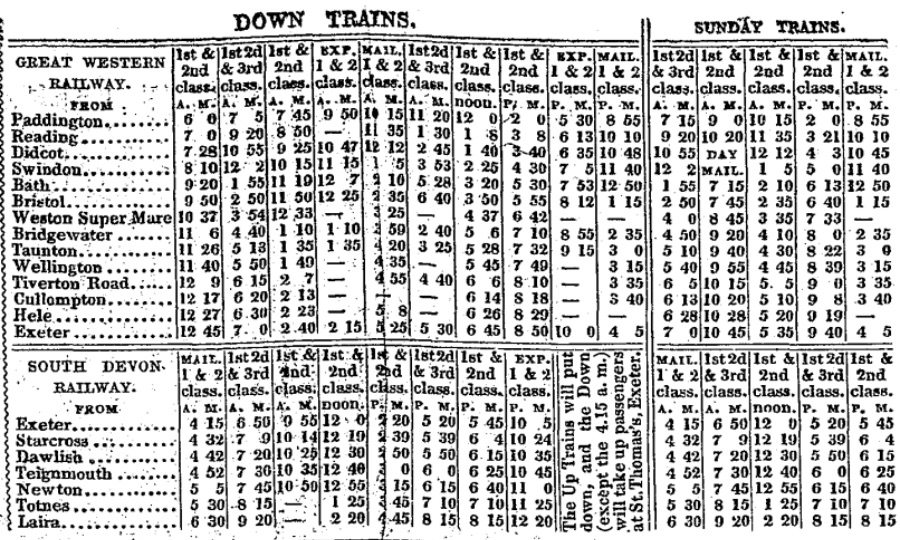
The train timetable in Trewman’s Exeter Flying Post from October 1848 showing the ’10 5′ (10:05pm) train from Exeter that was delayed by space weather.
<関連情報>
- https://www.rmit.edu.au/news/all-news/2026/sep/space-weather-train-delay
- https://agupubs.onlinelibrary.wiley.com/doi/10.1029/2026SW005239
1841年10月18日午後10時05分発エクセター発の列車は、宇宙天気の影響で出発が遅れたのか? Did Space Weather Delay the 10:05 p.m. Train Departure From Exeter on 18 October 1841?
James A. Wild, Ciaran D. Beggan, David H. Boteler, William B. Cade III, Brett A. Carter, Michael Hapgood
Space Weather Published: 16 September 2026
DOI:https://doi.org/10.1029/2026SW005239
Abstract
Although the Carrington Event of 1859 is typically cited as the first extreme space weather event of the scientific era, it is not the earliest example of modern human technology being impacted by geomagnetic activity. The literature includes reliable accounts of disturbances to telegraph equipment during geomagnetic storms dating to the late 1840s, but the rediscovery by Cade III (2013, https://doi.org/10.1002/swe.20091) of a report published in the journal Nature (1871, https://doi.org/10.1038/004441a0) suggests that the first recorded space weather impact may have occurred in 1841. The Nature article reports interference in the telegraph system of the South Devon Railway Company (England) on 18 October 1841 due to a “very intense magnetic disturbance” which caused the departure of the 10:05 p.m. express train from Exeter to Newton Abbot to be delayed by 16 min. However, our research reveals that the railway line from Exeter to Newton Abbot was not opened until 1846, so the timing of the events reported in Nature (some 30 years after the event) cannot be correct. In this study, we present the results of an investigation into contemporary records and geomagnetic observations that suggest the misreported 1841 event occurred several years later, on 18 October 1848. This places it after the first recorded event: the interference in electric telegraph systems of the Midland Railway in England during the auroral display of 19 March 1847. Nevertheless, the Exeter event still represents one of the earliest recorded examples of space weather impacting technical infrastructure.

