2026-09-16 森林林業技術センター
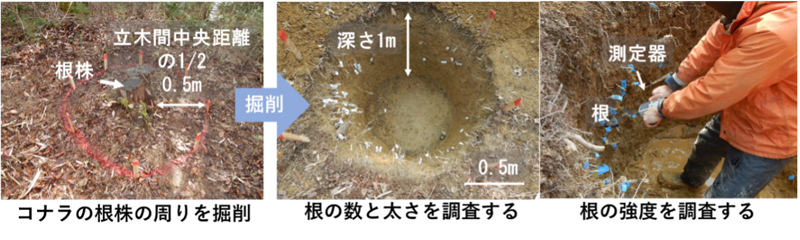
図1 コナラ根の分布と根の引き抜き抵抗力の調査
<関連情報>
- https://web.pref.hyogo.lg.jp/ns01/press/20260916.html
- https://web.pref.hyogo.lg.jp/ns01/press/documents/sankoushin.pdf
60年生コナラを伐採すると萌芽再生しても8年後まで根の土壌補強強度は低く推移する Root reinforcement remains low at 8 years after sprouting regeneration of 60-year-old Quercus serrata
Chikage Todo, Keitaro Yamase, Toko Tanikawa, Hidetoshi Ikeno, Mizue Ohashi, Masako Dannoura, Yasuhiro Hirano
Forest Ecology and Management Available online: 5 August 2026
DOI:https://doi.org/10.1016/j.foreco.2026.124131
Highlights
- Root reinforcement of old Quercus serrata remains low 8 years after cutting.
- Increased dead roots after cutting results in a decline in root reinforcement.
- Root reinforcement was related with basal area of stump 5 years after cutting.
- At 8 years, cross-sectional area of sprouts was correlated with reinforcement.
- Root reinforcement 8 years after cutting was higher in sprouts than seedlings.
Abstract
Regeneration of Quercus serrata has traditionally occurred through coppicing. Currently, most Q. serrata forests are left unmanaged, resulting in an increased number of large-stem trees. When coppicing is carried out to prevent these large trees from overturning, the hazard of slope failure increases because of decline in root reinforcement post cutting. However, the extent to which root reinforcement in Q. serrata declines following coppicing, and the underlying processes involved, remains poorly understood. Here, we aimed to elucidate the decline and recovery processes of root reinforcement in Q. serrata at 5 and 8 years following clear cutting in an abandoned stand. Root reinforcement decreased sharply to 3.51 kPa and remained low at 1.99 kPa by 5 and 8 years, respectively, after cutting—corresponding to 10% and 6% of the before-cutting values. The reinforcement at 5 years was significantly related to the stem basal area of the stumps, and that at 8 years was related to the cross-sectional area of the sprouts. The number of roots per soil profile area at 5 and 8 years was significantly lower than that before cutting. Living roots that appeared to have regenerated were shallower than dead roots. These results suggest that the old root system of Q. serrata did not remain intact but the roots were regenerated. Accordingly, we propose that management practices aimed at promoting sprout growth are more effective than relying on natural regeneration for reducing the hazard of soil failure and accelerating the recovery of root reinforcement.