2026-10-01 日本原子力研究開発機構,北海道大学,国立環境研究所
<関連情報>
- https://www.jaea.go.jp/02/press2026/p26100103/
- https://www.sciencedirect.com/science/article/pii/S0921344926003137
日本のスギ林の持続可能な管理による国家カーボンニュートラルの実現 Sustainable management for Japan’s cedar stands towards national carbon neutrality
Masakazu Ota, Kentaro Takagi, Naishen Liang, Yoshiyuki Takahashi, Jun Koarashi
Resources, Conservation and Recycling Available online: 27 July 2026
DOI:https://doi.org/10.1016/j.resconrec.2026.109089
Abstract
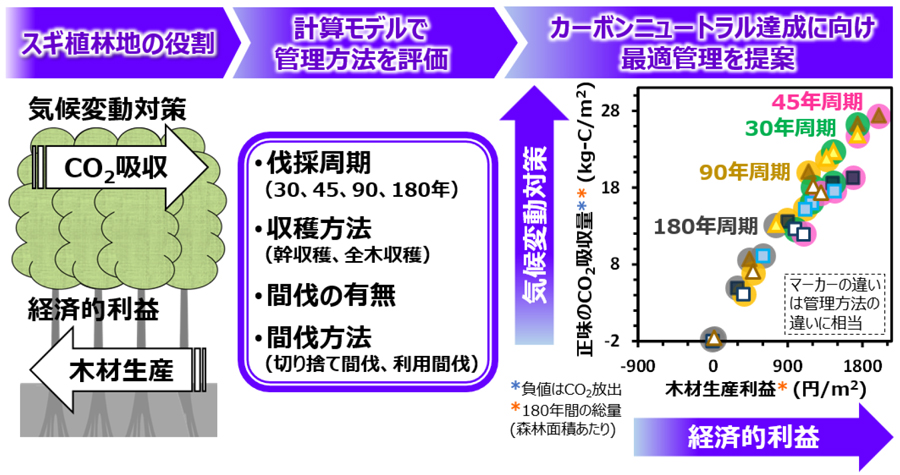
To achieve carbon neutrality by 2050, Japan is revitalizing forestry. However, it is unclear which specific management methods should be implemented. Using a numerical model, we explore the carbon balance and economic outcomes of feasible management practices for Japanese cedar (Cryptomeria japonica) plantations, Japan’s most economically important forest type. We show that repeated 45-year rotation cycles maximize carbon dioxide sequestration and generate highest revenue from wood production. Applying this management to cedar stands in Japan, combined with utilization thinning and whole-tree harvesting, potentially contributes 35%–73% of Japan’s 2030 interim target of carbon dioxide absorption by forests, offsetting 1.4%–3.0% of the national net emission target. However, the sustainability of this approach depends on subsidies (coverage rates 0%–90%), which must cover over two-thirds of forestry costs. These findings indicate that continued and sufficient support for the forestry sector is essential to enable Japan’s aging cedar plantations to help achieve national carbon neutrality.