2026-07-08 京都大学
京都大学を中心とする国際共同研究グループは、森林における樹木の競争と共存の仕組みを統一的に説明する新たな解析手法を開発し、「なぜ巨木だけが森林を独占せず、小さな木々と長期にわたり共存できるのか」という長年の謎を解明した。研究では、森林内の光環境の三次元分布と樹木の三次元構造を解析し、樹木の成長を「光を獲得する効率」と「獲得した光を成長へ変換する効率」の二つの要素に分けて評価した。その結果、若い森林では光を多く獲得できる大型個体が急速に成長してサイズ格差が拡大する一方、森林が成熟すると光利用効率の重要性が高まり、弱い光でも効率よく成長できる小型樹木が独自の生態的地位(ニッチ)を確立して共存することが明らかになった。すなわち、森林の発達に伴い「光獲得重視」から「光利用重視」へと成長戦略が転換することが、多様な樹木の共存を支える基本原理であることを世界で初めて示した。本成果は、森林生態系の維持機構の理解を深めるとともに、生物多様性保全や森林管理、気候変動下での森林動態予測への応用が期待される。
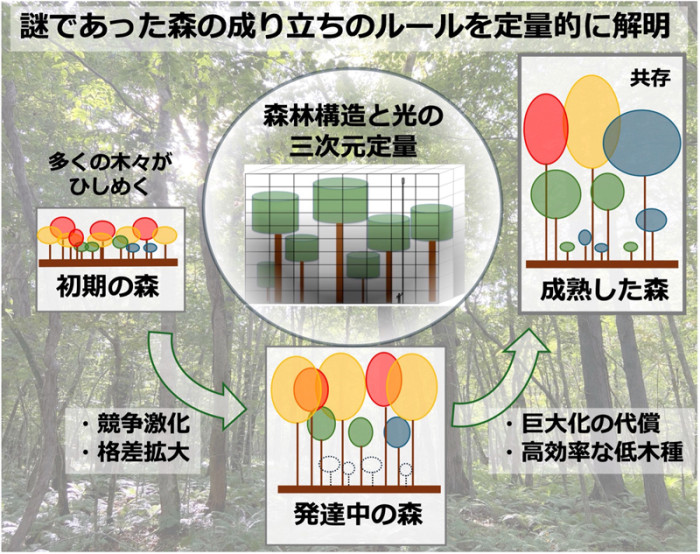
本研究が開発した「森林構造と光の三次元定量技術」によって、森の成り立ちに関する長年の謎――「光を巡る激しい競争の中で、なぜ樹木は共存できるのか」を、統一的に説明できるようになりました。作成:小野田雄介
<関連情報>
- https://www.kyoto-u.ac.jp/ja/research-news/2026-07-08-1
- https://www.kyoto-u.ac.jp/sites/default/files/2026-07/web-2607-Onoda-c849b808912113f7502eb4e9039ff3e0.pdf
- https://besjournals.onlinelibrary.wiley.com/doi/10.1111/1365-2745.70375
樹木の成長を光獲得と光利用効率にわけることによって森林の二次遷移における光競争の役割を明らかにする Partitioning tree growth into light interception and use efficiencies clarifies the role of light competition in secondary forest succession
Yusuke Onoda, Tomonari Matsuo, Keito Kobayashi, Tsutom Hiura
Journal of Ecology Published: 07 July 2026
DOI:https://doi.org/10.1111/1365-2745.70375
Abstract
- Light competition is a fundamental force driving tree height growth and secondary succession. However, the costs and benefits of light interception and growth at the individual tree level remain poorly understood, largely due to the technical challenges of measuring light interception in natural forests.
- By adopting in situ measurement of light interception with a novel analytical framework, we decomposed the individual relative growth rate (RGR) into two components: light interception efficiency (LIE), defined as light intercepted per unit of above-ground biomass, and light use efficiency (LUE), defined as biomass gain per unit of intercepted light (that is, RGR = LIE × LUE). Using this analytical framework, we analysed individual tree growth rates in relation to light interception and use to examine how light competition drives size variations and its consequences for forest development during secondary succession.
- This study was carried out in 12 forest stands of varying ages in Hokkaido, Japan. For all co-occurring trees with stem diameters >1 cm, we quantified growth and light interception using 3D crown geometries and forest light profiles.
- In young stands, RGR was positively correlated with tree height, driving rapid vertical growth and stratification. In older stands, this relationship weakened or reversed, contributing to size-structure stabilization and the coexistence of different size species. Across all stages, taller trees had higher LIE, indicating size-asymmetric competition. Conversely, taller trees had consistently lower LUE than shorter trees, likely due to ecophysiological constraints. In young stands, the advantage of higher LIE outweighed the lower LUE of taller trees, resulting in their higher RGR. In older stands, the relative benefit of higher LIE diminished while the LUE of smaller trees increased; this reduced the growth advantage of canopy individuals and promoted the regeneration of the understory.
- Synthesis. This mechanistic framework clarifies how light competition drives forest dynamics. The transition from rapid height stratification to structural stabilization and species coexistence is governed by the shifting balance between size-dependent light interception and use efficiencies.