2026-09-15 北海道大学
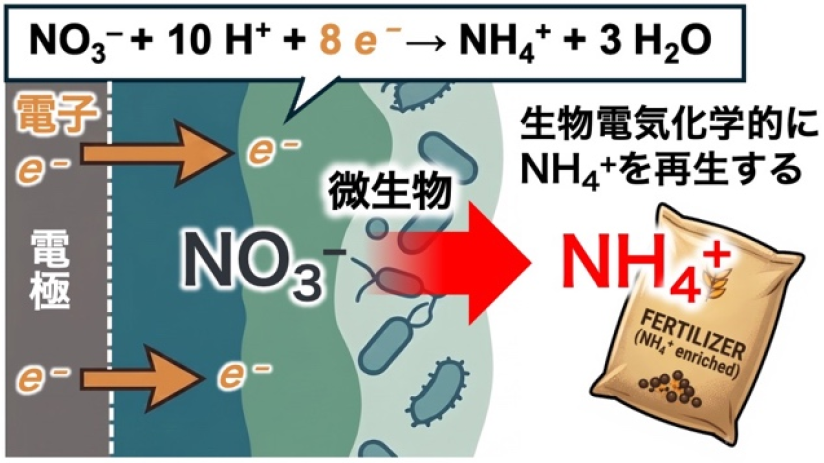
環境中へ大量に散逸する硝酸(NO3–)を生物電気化学的にNH4+へ戻し、再生肥料化する。
<関連情報>
- https://www.hokudai.ac.jp/news/2026/09/post-2443.html
- https://www.sciencedirect.com/science/article/pii/S1385894726091734
水溶性電子伝達体を用いた生物電気化学プロセスによる硝酸のアンモニウム再生 Soluble-electron mediator assisted bioelectrochemical reduction of nitrate to ammonium for nitrogen recovery
Yunjeong Choi, Nichika Takahashi, Satoshi Okabe, Mamoru Oshiki
Chemical Engineering Journal Available online: 7 September 2026
DOI:https://doi.org/10.1016/j.cej.2026.181710
Highlights
- First demonstration of soluble-mediator-assisted bioelectrochemical NO3− reduction to NH4+
- High NO3− reduction activity; 10.9 mmol-N L−1 day−1 and Ks = 0.19 mM
- Efficient NO3− reduction in natural water matrices at 1 mM NO3−
- Faradaic efficiency in natural water matrices; 50–59%
- Electricity consumption in natural water matrices; 188–192 kWh kg-NO3−-N−1
Abstract
Bioelectrochemical reduction of dilute nitrate (NO3−; sub-mM) to ammonium (NH4+) is a promising route toward circular nitrogen management from nitrate-contaminated groundwater and surface waters. However, conventional bioelectrochemical systems (BES) rely on extracellular electron transfer through electrode-attached biofilms, restricting catalysis to a few electroactive bacteria in direct contact with the electrode. Here, we developed a soluble-mediator-assisted BES in which a diffusible mediator shuttles electrons to suspended cells throughout the catholyte, enabling weakly electroactive bacteria to serve as nitrate-reduction catalysts. Three biocatalysts (Escherichia coli, Shewanella oneidensis, and Candidatus Brocadia sinica), nine soluble mediators spanning viologens, quinones, and phenazines, cathodic potentials from −0.3 to −0.9 V, and pH 6.5 to 8.5 were screened, and NO3− reduction to NH4+ was confirmed using a 15NO3− tracer. With E. coli cells and methyl viologen, NO3− was reduced to NH4+ at a maximum volumetric rate of 10.9 mmol-N L−1 day−1 and a low NO3−-affinity constant (Ks = 0.19 mM). This rate was 8-fold higher than previously reported biofilm-based systems, and NO3− reduction was repeated over three successive NO3− additions during 48 h of operation. Furthermore, the soluble-mediator-assisted BES showed high performance even in natural groundwater and surface water, with a Faradaic efficiency of 50–59% and an electricity consumption of 188–192 kWh kg-NO3−-N−1, substantially lower than metal-catalyst systems at comparable NO3− concentration. These findings demonstrate that soluble-mediator-assisted BESs provide an energy-efficient platform for converting NO3− in natural water into a recoverable NH4+ form, with full nitrogen recovery additionally requiring downstream NH4+ concentration or separation.