2026-09-11 スタンフォード大学
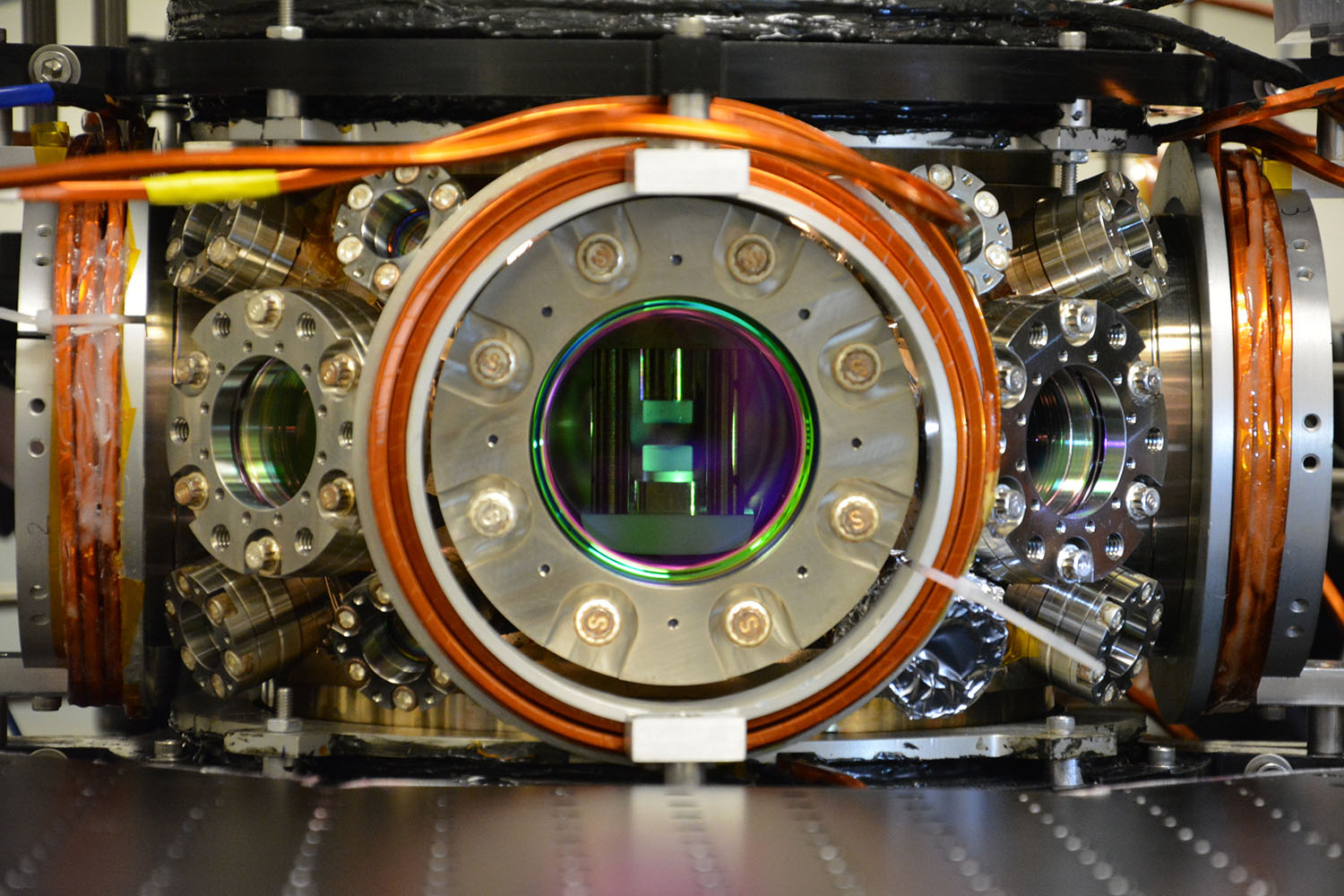
Physicists built this apparatus to create a new spin glass out of atoms and photons. | Benjamin Lev
<関連情報>
- https://news.stanford.edu/stories/2026/09/spin-glass-memory-ai-research
- https://www.science.org/doi/10.1126/science.aec3917
量子光学スピングラスにおける高容量連想メモリ High-capacity associative memory in a quantum-optical spin glass
Brendan P. Marsh, David Atri Schuller, Yunpeng Ji, Henry S. Hunt, […] , and Benjamin L. Lev
Science Published:3 Sep 2026
DOI:https://doi.org/10.1126/science.aec3917
Abstract
The Hopfield neural network stores memories using all-to-all-coupled spins and recalls those memories through equilibrium dynamics. Storing too many hampers recall because frustration causes an exponential number of spurious patterns to arise as the network becomes a spin glass. Despite this, memory recall can be restored, and even enhanced, under quantum-optical nonequilibrium dynamics because spurious patterns can now serve as reliable memories. We experimentally observe associative memory with high storage capacity in a driven-dissipative spin glass made of atoms and photons. The capacity surpasses that of the Hopfield model under Hebbian learning by up to seven-fold in a sixteen-spin network. Atomic motion boosts capacity by dynamically modifying connectivity akin to short-term synaptic plasticity in neural networks, realizing a precursor to learning in a quantum-optical system.