
CO₂変換を高性能化する自立型ナノワイヤ電極(Self-Supported Nanowire Electrodes Improve CO₂ Conversion)

2026-09-15 合肥物質科学研究院(HFIPS)
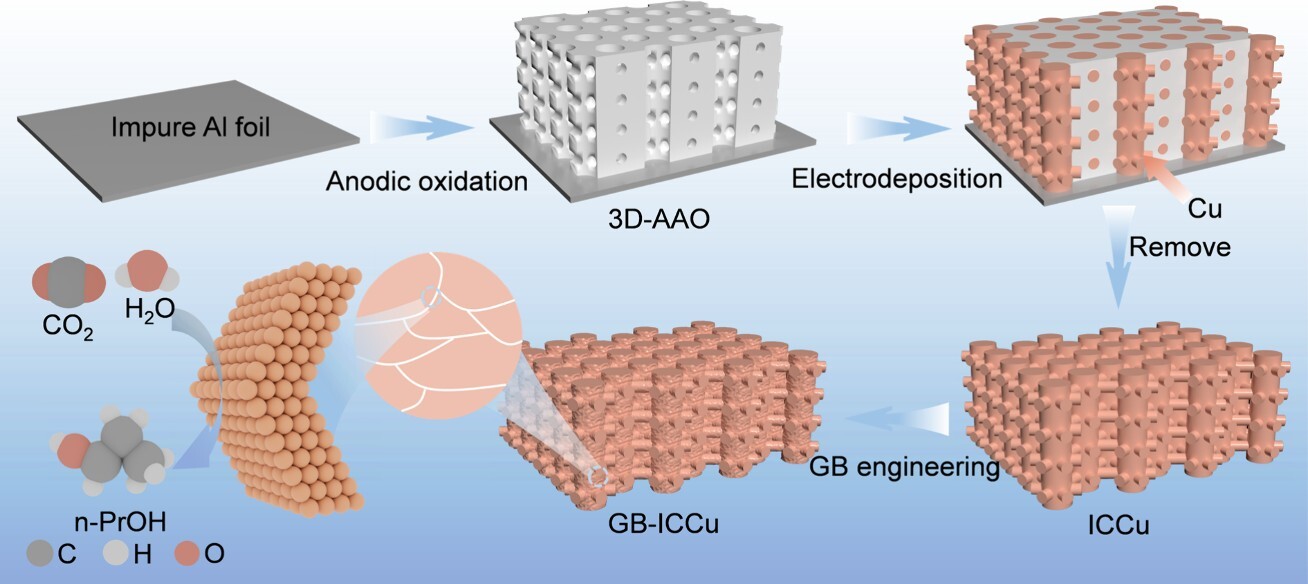
中国科学院合肥物质科学研究院の研究チームは、CO₂電解還元の効率と安定性を高める自己支持型ナノワイヤ電極を開発した。従来電極で用いられる高分子バインダーを使わず、横方向に連結した細孔を持つ3D陽極酸化アルミナ(3D-AAO)テンプレートから、三次元多孔質の規則配列ナノワイヤ電極を作製した。銀ナノワイヤ電極「3D-ICAg」は、CO₂からCOへの変換でファラデー効率97.28%、電流密度59.06 mA cm⁻²を達成し、50時間安定して作動した。また、銅ナノワイヤ電極「GB-ICCu」は、表面の粒界とナノ閉じ込め効果によりC–C結合形成を促進し、CO₂からn-プロパノールを生成。H型セルで17.47%のファラデー効率、フローセルで77.7 mA cm⁻²の部分電流密度を示した。これらの成果は、三次元構造による物質移動と活性点へのアクセス向上が、CO₂資源化電極の高性能化に有効であることを示す。

CO₂変換を高性能化する自立型ナノワイヤ電極(Self-Supported Nanowire Electrodes Improve CO₂ Conversion)
Schematic illustration of the synthesis process of the GB-ICCu electrode (Image by TANG Haibin)

<関連情報>

二酸化炭素を一酸化炭素に効率的かつ選択的に電気還元するための三次元相互接続銀ナノワイヤ膜 Three-Dimensionally Interconnected Silver Nanowire Membrane for Efficient and Selective Electroreduction of Carbon Dioxide to Carbon Monoxide

Pengxiang Wang, Lei Wang, Haibin Tang, Ao Wang, Dongran Wang, He Liu, Chenyu Cai, Fangming Han, Guowen Meng
ENERGY & ENVIRONMENTAL MATERIALS  Published: 10 August 2026
DOI:https://doi.org/10.1002/eem2.70498

Abstract

Silver-based nanostructures are widely believed as the promising catalysts for electrocatalytic reduction of carbon dioxide toward carbon monoxide. However, most reported Silver-based catalysts are typically synthesized in powder form and require polymeric binders for electrode fabrication, resulting in several interrelated issues including blocked active sites, poor electrical conductivity, limited mass transport, and weak adhesion between the catalyst layer and the substrate. Herein, utilizing a three-dimensionally porous anodic aluminum oxide template, a self-supported 3D interconnected Ag nanowire membrane is fabricated as a electrocatalytic reduction of carbon dioxide electrode. This unique architecture offers a large electrochemical active surface area and abundant active sites, enabling the efficient and highly selective conversion of carbondioxide to carbon monoxide over a wide potential window, with a maximum Faradaic efficiency for carbon monoxide of 97.28% and high current density of 59.06 mA cm−2 in the typical H-type cell. Furthermore, the scaffold-like 3D interconnected structure ensures excellent structural stability, guaranteeing long-term operational durability. This work provides a novel catalyst design strategy for highly selective electrocatalytic reduction of carbon dioxide to carbon monoxide and a feasible solution for durable self-supporting electrodes.
ナノ閉じ込めと粒界の相乗的結合により、電気触媒によるCO2還元によるn-プロパノール 生成が促進される Synergistic Coupling between Nanoconfinement and Grain Boundary Improves Electrocatalytic CO2 Reduction to n‑Propanol

Lei Wang;Pengxiang Wang;Yujing Liu;Dongran Wang;Fangming Han;Xing Chen;Xiangfu Meng;Xiaoyang Zheng;Qiquan Luo;Haibin Tang;Guowen Meng
ACS Nano  Published:

Cu-based nanomaterials are recognized as the most promising catalysts for electrocatalytic CO2 reduction to produce valuable multicarbon products (C2+). However, the low localized concentration of *C1 and *C2 intermediates and poor availability of active sites limit the CO2 conversion efficiency and selectivity for C2+. Herein, a three-dimensional interconnected self-supporting Cu nanowire array with rich grain boundaries (GB-ICCu) is designed to obtain high production of C2+, especially n-propanol (n-PrOH), due to the synergistic coupling between the nanoconfinement effect and the grain boundary. The finite element simulations and experimental results reveal that the three-dimensional interconnected structure between Cu nanowires, like a nanoscaffolding, induces a pronounced nanoconfinement of *C1 and *C2 intermediates and consequently enhances the selectivity toward n-PrOH. Meanwhile, the rich grain boundaries of the (111) and (200) on the surface of each Cu nanowire also strengthen CO2 activation and intermediate adsorption, thereby reducing the energy barrier for C–C coupling. As a result, a high Faradaic efficiency of 17.47% and a partial current density of 10.44 mA cm–2 for n-PrOH are achieved in the H-type cell, while 12.05% and 77.7 mA cm–2 are achieved in the flow cell, respectively, which present an advance in partial current density of n-PrOH, i.e., the yield rate of n-PrOH. This work provides a strategy and a Cu-based electrocatalyst for C3 synthesis via CO2 reduction.


0402電気応用
ad
ad
Follow
ad
タイトルとURLをコピーしました