2026-09-14 コロンビア大学
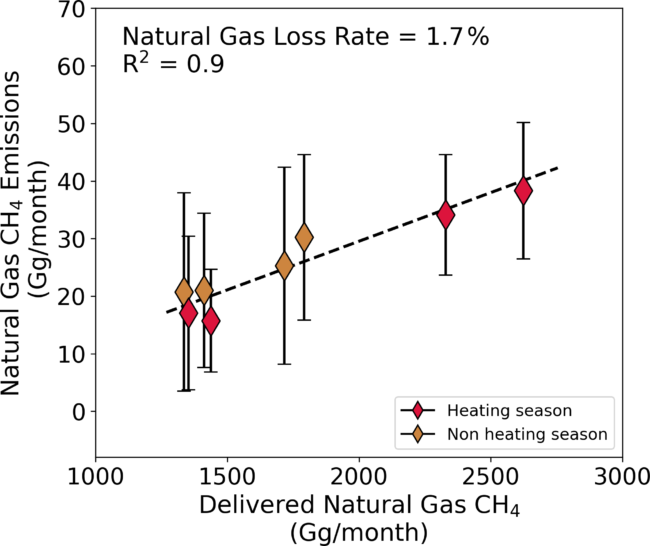
This chart shows monthly natural gas delivered in 2023 and 2024 to New York City and northeastern New Jersey (horizontal axis) against measured natural gas methane emissions (vertical axis). Red diamonds represent heating months and orange diamonds represent cooling months. The dotted line indicates a steady 1.7% natural gas loss rate throughout the seasons.
<関連情報>
- https://news.climate.columbia.edu/2026/09/14/unused-natural-gas-behind-nycs-300-million-waste-of-a-potent-greenhouse-gas/
- https://acp.copernicus.org/articles/26/12911/2026/
天然ガスの非効率的な消費が巨大都市からのメタン排出を引き起こしている Inefficient consumption of natural gas drives methane emissions from a megacity
Yuwei Zhao, Andrew Hallward-Driemeier, Luke D. Schiferl, Trey Maddaleno, Michael P. Vermeuel, Dylan B. Millet, Delphine Farmer, and Róisín Commane
Atmospheric Chemistry and Physics Published:14 Sep 2026
DOI:https://doi.org/10.5194/acp-26-12911-2026
Abstract
Reducing methane emissions offers a significant near-term opportunity for climate mitigation if the dominant sources are effectively targeted. Natural gas is a large and manageable methane source. Despite extensive pipeline upgrades in cities, methane reductions remain far smaller than expected, suggesting missing emission pathways. Using long-term tower observations in a U.S. megacity, we found a strong seasonal cycle in methane emissions peaking during the winter heating and summer cooling seasons. Natural gas methane emissions dominated both seasons and were strongly correlated with consumption, yielding a loss rate of 1.7±0.6 %, equivalent to about 300×106 USD yr−1 of unused natural gas. Incomplete combustion was the primary natural gas signal observed, indicating future mitigation planning should prioritize inefficient natural gas consumption.