2026-08-11 ジョージア工科大学
<関連情報>
- https://news.research.gatech.edu/2026/08/11/georgia-tech-researchers-discover-new-mechanism-behind-soft-material-adhesion
- https://www.me.gatech.edu/news/georgia-tech-researchers-discover-new-mechanism-behind-soft-material-adhesion
- https://www.pnas.org/doi/10.1073/pnas.2536311123
ハイドロゲルの非単調な速度依存性接着 Nonmonotonic rate-dependent adhesion of hydrogels
Dongjing He, Jiahe Huang, and Yuhang Hu
Proceedings of the National Academy of Sciences Published:March 18, 2026
DOI:https://doi.org/10.1073/pnas.2536311123
Abstract
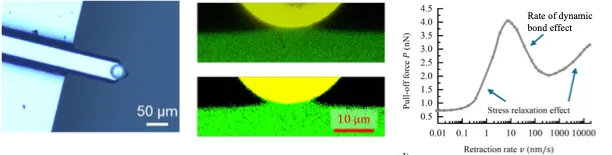
Hydrogel adhesion underlies a wide range of biological and engineering functions, yet its rate dependence remains poorly understood. Classical adhesive systems exhibit a monotonic increase in adhesion strength with separation rate, a behavior attributed to bond stress relaxation. Here, we show that hydrogels fundamentally deviate from this paradigm. Using atomic force microscopy-based indentation over six orders of magnitude in retraction rate, we find that the pull-off force first decreases and then increases, revealing a distinctly nonmonotonic rate dependence in hydrogels. To explain this behavior, we develop a quantitative model that couples the deformation of the hydrogel with a rate-dependent traction carried by interfacial bonds with distinct association and dissociation kinetics. The model reproduces the full pull-off force spectrum exhibiting the nonmonotonic behavior and predicts the evolution of the contact radius during detachment. In situ confocal microscopy measurements of contact-area dynamics confirm these predictions, providing independent validation of the kinetic mechanism. Together, the experiments and theory reveal that hydrogel adhesion is governed by a competition between time-dependent bond formation, which strengthens adhesion at slow rates, and limited bond relaxation, which enhances traction at fast rates. This interplay produces a broad intermediate regime in which reduced contact time suppresses bond buildup and weakens adhesion. Our findings identify a previously unrecognized adhesion regime in polymeric materials and provide a unified framework for understanding and designing hydrogel interfaces whose performance depends sensitively on rate, contact history, and interfacial bonding kinetics.