2026-04-20 コペンハーゲン大学
<関連情報>
- https://news.ku.dk/all_news/2026/04/stone-age-population-collapse-revealed-by-dna-study-in-france/
- https://www.nature.com/articles/s41559-026-03027-z
パリ盆地における人口の断絶は、新石器時代の衰退の証拠と関連している Population discontinuity in the Paris Basin linked to evidence of the Neolithic decline
Frederik V. Seersholm,Abigail Ramsøe,Jialu Cao,Philippe Chambon,Karl-Göran Sjögren,Hugh McColl,Fabrice Demeter,Charleen Gaunitz,Lasse Vinner,Jesper Stenderup,Gabriele Scorrano,Ralph Fyfe,T. Douglas Price,Morten Fischer Mortensen,Sascha Krüger,Torben Dehn,Svend Illum Hansen,Kristine Vesterdorf,Thorfinn Sand Korneliussen,Morten E. Allentoft,Kristian Kristiansen,Laure Salanova,Eske Willerslev & Martin Sikora
Nature Ecology & Evolution Published:03 April 2026
DOI:https://doi.org/10.1038/s41559-026-03027-z
Abstract
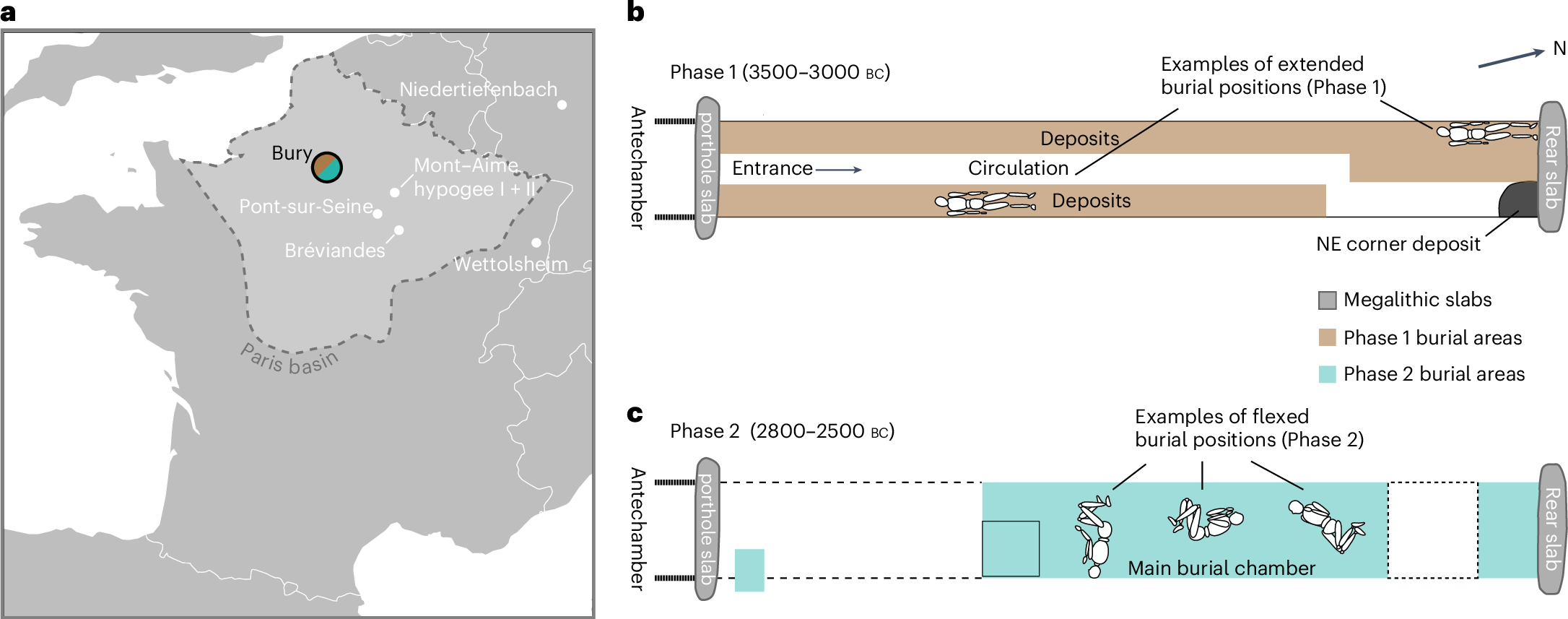
At the transition between the third and the fourth millennium BC, there is evidence for a population decline concurrent with the end of megalith building across continental northwestern Europe. In Scandinavia this ‘Neolithic decline’ is followed by a massive population turnover, as farming communities disappeared and were replaced by people with steppe ancestry. In western Europe, however, ancestry associated with Neolithic farmers persisted beyond the Neolithic decline, and it remains unclear whether a similar demographic replacement occurred. To investigate the population dynamics around the Neolithic decline in present-day France, we sequenced 132 ancient genomes from the allée sépulcrale at Bury. Located in the Paris area, Bury spans two burial phases separated by a hiatus with no burial activity: one phase directly preceding the Neolithic decline in the late fourth millennium BC, ending around 3000 BC, and a later phase some time after the Neolithic decline in the early- to mid-third millennium BC. Our analysis revealed that the two burial phases at Bury represented largely discontinuous genetic groups of a markedly different social organization as inferred from three large pedigrees. We show that the difference between the two burial phases can be linked to a northwards movement of Neolithic ancestry from the south, which only spread into the Paris Basin after the Neolithic decline, at around 2900 BC. Together with genetic evidence of various infectious diseases in the dataset, such as Yersinia pestis and Borrelia recurrentis, as well as evidence for forest regrowth between the two phases, these findings detail a population turnover at the end of the fourth millennium BC, offering a possible explanation for the cessation of megalith building.