2026-08-06 ワシントン大学セントルイス校
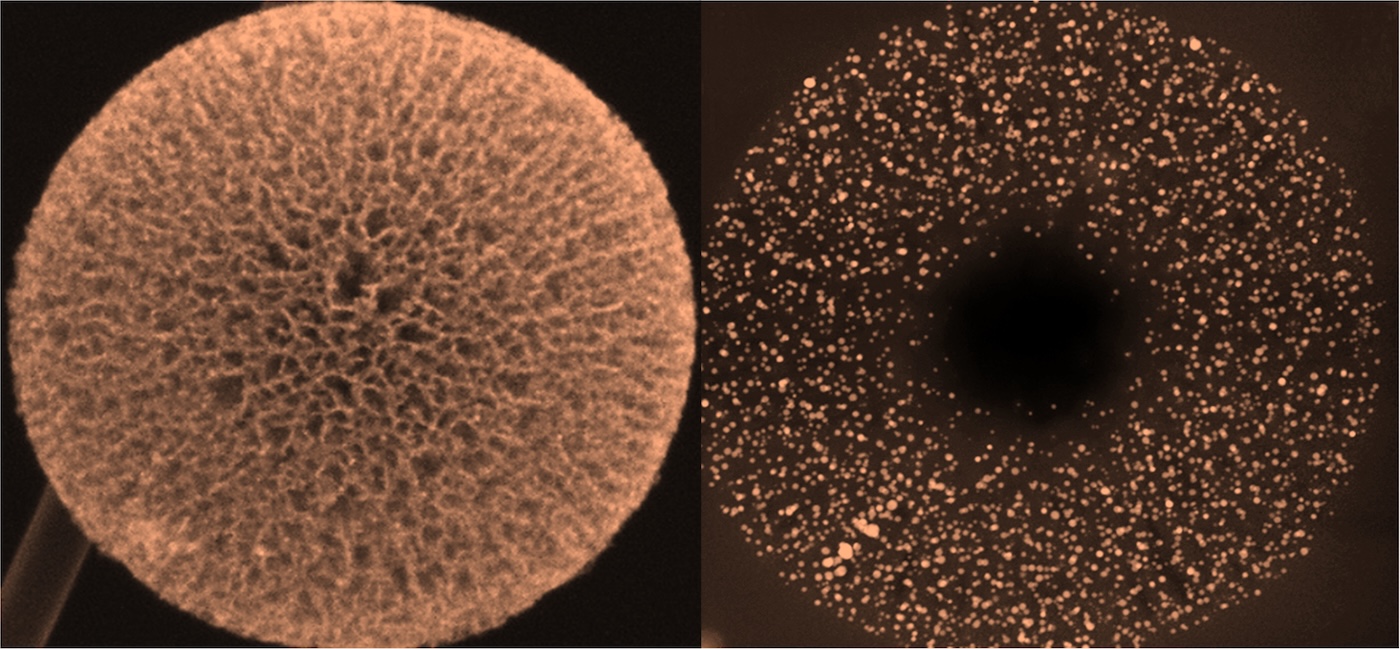
Gang Wu and collaborators developed hollow nanocarbon spheres containing an ordered radial nanochannel array to be used as supports in their new design for high-performance intermetallic nanoparticle fuel cell catalysts. (Image: Wu lab)
<関連情報>
- https://source.washu.edu/2026/08/platinum-powers-the-future/
- https://www.nature.com/articles/s41565-026-02244-8
放射状ナノチャネルアレイカーボンにより、高性能金属間化合物燃料電池触媒が実現 Radial nanochannel-array carbon enables high-performance intermetallic fuel cell catalysts
Lei Gao,Sooyeon Hwang,Xiaorui Li,Jiamao Zheng,Kwanpyung Lee,Shuo Liu,Dominik Wierzbicki,Jialu Li,Jinghua Guo,Bingzhang Zhang,Honghong Lin,Qing Zhao,Guofeng Wang,Chaochao Dun & Gang Wu
Nature Nanotechnology Published:06 August 2026
DOI:https://doi.org/10.1038/s41565-026-02244-8
Abstract
The challenge of designing platinum-based intermetallic catalysts for oxygen-reduction cathodes in fuel cells is to synergistically integrate four critical merits into one catalyst, including fine metal nanoparticles, high ordering degree of intermetallic structure, high Pt content against support and mesopore-rich carbon supports for favourable ionomer dispersion and mass/charge transfers. Here we introduce a radial nanochannel-array carbon sphere (RNCS) support that contains open-through-grooved mesopores with sufficient volume and optimal size. PtCo intermetallic nanoparticles are uniformly assembled into the RNCS to achieve exceptional thermal and electrochemical stability. Annealing at desirable elevated temperatures (>1,000 °C) simultaneously yields highly ordered L10-PtCo intermetallic phases (>80%) and fine particle dispersion (<5 nm), even at a high Pt content of 40 wt%. The RNCS support enables all these merits in a single catalyst due to its ordered mesoporous structures with effective nanoconfinement, and the supported PtCo intermetallic catalyst in membrane electrode assemblies delivered a compelling current density of 2.12 A cm−2 at 0.70 V under heavy-duty vehicle conditions and retained 82.5% performance after a rigorous accelerated stress test of 150,000-voltage cycles.