2026-08-06 ペンシルベニア州立大学(Penn State)
<関連情報>
- https://www.psu.edu/news/eberly-college-science/story/creating-chemical-reactions-run-oxygen-produce-only-water-waste
- https://pubs.acs.org/jacsat/article/148/27/28122/5211117/Mimicking-Extradiol-Dioxygenase-Reactivity-on
イリジウム上でのエクストラジオールジオキシゲナーゼ反応の模倣 Mimicking Extradiol Dioxygenase Reactivity on Iridium
Alexander G. Arnette;Anant Kumar Jain;Alexey Silakov;Karen I. Goldberg;Jonathan L. Kuo
Journal American Chemical Journal Published:June 10, 2026
DOI:https://doi.org/10.1021/jacs.5c23353
Abstract
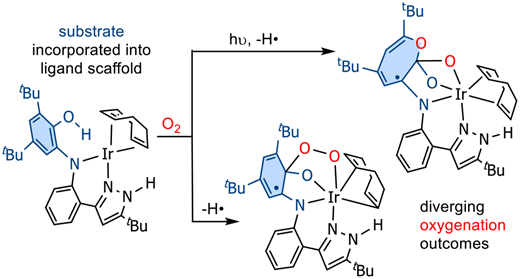
Extradiol dioxygenases catalyze the cleavage of benzenediol (catechol) or vicinal aminophenols via oxygen atom insertion into the 2,3-C–C bond. These reactions are most often proposed to proceed through the migratory rearrangement of a d6 alkylperoxide, generating the corresponding d6 ring-expanded product. However, regiospecific insertion remains a rare outcome among synthetic model complexes. Here, a dioxygenated Ir complex (2) converts to (a) the paramagnetic metallatrioxolane (3) and (b) oxygen atom-inserted products (4) and (5); all three complexes are third-row metal analogues of enzymatic intermediates. The conversion of 2 to 3 was triggered by an H• abstraction, generating a third-row metallatrioxolane that is one electron reduced from the canonical d6 alkylperoxide. Alternatively, photolysis of 2 (467 nm) results in ring-expanded product 4, from which an H• can be abstracted to generate 5. This latter complex is also one electron reduced relative to the canonical ring-expansion product. Because extradiol mechanisms were largely defined using Fe(II) metallocofactors, 3 and 5 may be especially relevant to the known Co(II)-accepting variants. We propose these states became synthetically accessible via the incorporation of a catechol-like substrate into the larger, multidentate ligand L1. This perturbation enhances the affinity of L1 (and related intermediates) to the metal. The same perturbation may have also been key in characterizing the first κ2-bound, dianionic ortho ester ligand─the observed binding mode in the X-ray structure of 5. Broadly, we propose that connecting a biological dioxygen complexes to nonheme oxygenase-like intermediates provides useful insights for regiospecific aerobic oxygenations.