2026-07-07 京都大学
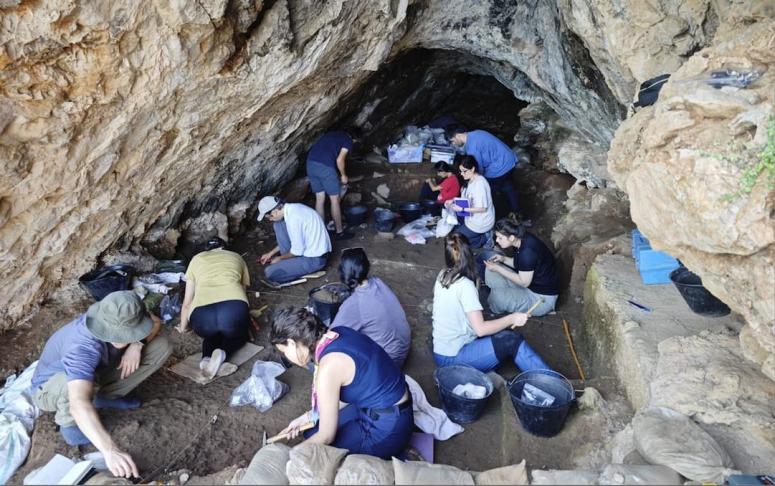
ウチャーズリII洞窟での発掘の様子(2024年撮影)
<関連情報>
- https://www.kyoto-u.ac.jp/ja/research-news/2026-07-07
- https://www.kyoto-u.ac.jp/sites/default/files/2026-07/web-2607-Morimoto-277167ad2589f40818b7be78e7beb280.pdf
- https://www.pnas.org/doi/10.1073/pnas.2609061123
レバント北部、ウチャーズリII洞窟における、ネアンデルタール人と現生人類にまたがり長期に渡った文化の連続性 Long-term cultural continuity across the Neanderthal–modern human sequence at Üçağızlı II Cave, northern Levant
İsmail Baykara Didem Turan, Ece Eren Kural, +7 , and Naoki Morimoto
Proceedings of the National Academy of Sciences Published:July 6, 2026
DOI:https://doi.org/10.1073/pnas.2609061123
Abstract
We present evidence from Üçağızlı II Cave in the northern Levant, Türkiye, documenting the sequential occupation by Neanderthals (Homo neanderthalensis; 77–59 ka) and modern humans (Homo sapiens; 59–47 ka). The combined evidence of human fossils, faunal and floral remains, lithics, and manuports demonstrates significant behavioral and technological continuity across this taxonomic sequence, characterized by consistent subsistence strategies and the persistent selection and transport of specific nondietary mollusk shells. The lithic assemblages largely align with late Middle Paleolithic traditions, exhibiting characteristic Mousterian variants. The association of diagnostic human fossils with these archaeological remains demonstrates that the shift from Neanderthals to modern humans occurred within a cultural continuum. Our findings suggest shared behaviors between Neanderthals and modern humans that extended beyond subsistence to include nonutilitarian behaviors within the specific geographic and temporal context studied here.