2026-04-13 ペンシルベニア州立大学(Penn State)
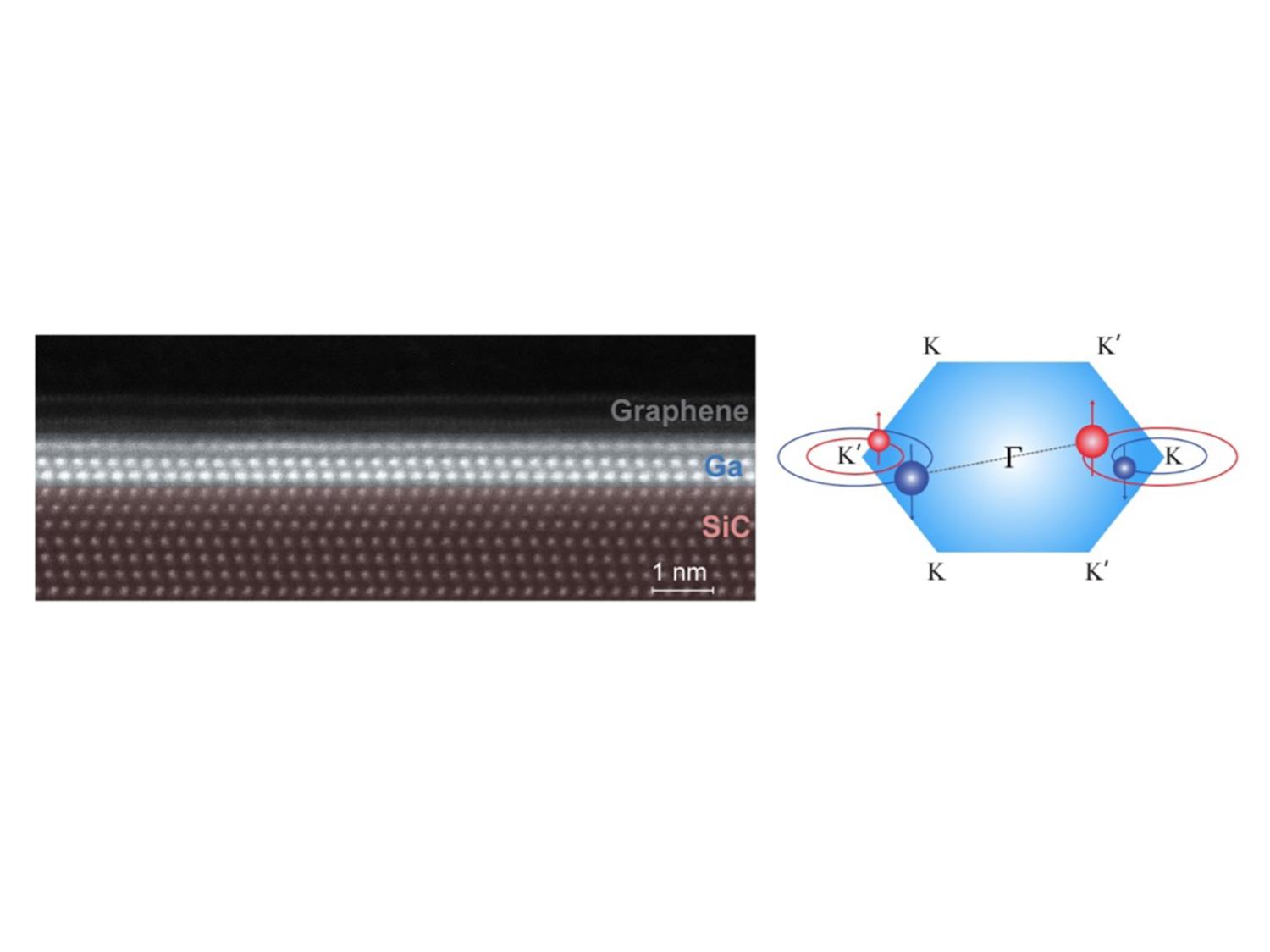
Penn State MRSEC researchers have uncovered unusual superconductivity in a lightweight element gallium sandwich structure. Left: Cross-sectional scanning transmission electron microscopy image of a three-atomic-layer gallium film sandwiched between graphene and a silicon carbide substrate. Right: Schematic of Ising-type superconductivity in this gallium layer. Credit: Chang Laboratory / Penn State. Creative Commons
<関連情報>
- https://www.psu.edu/news/research/story/unlocking-unusual-superconductivity-lightweight-element
- https://www.nature.com/articles/s41563-026-02573-y
閉じ込められたガリウム層における軌道混成によって誘起されるイジング型超伝導 Orbital-hybridization-induced Ising-type superconductivity in a confined gallium layer
Hemian Yi,Yunzhe Liu,Chengye Dong,Yiheng Yang,Zi-Jie Yan,Zihao Wang,Lingjie Zhou,Dingsong Wu,Houke Chen,Stephen Paolini,Bing Xia,Bomin Zhang,Xiaoda Liu,Hongtao Rong,Annie G. Wang,Saswata Mandal,Kaijie Yang,Benjamin N. Katz,Lunhui Hu,Jieyi Liu,Tien-Lin Lee,Vincent H. Crespi,Yuanxi Wang,Yulin Chen,… Cui-Zu Chang
Nature Materials Published:13 April 2026
DOI:https://doi.org/10.1038/s41563-026-02573-y
Abstract
In low-dimensional superconductors, the interplay between quantum confinement and interfacial hybridization effects can reshape Cooper-pair wavefunctions and give rise to unconventional superconducting states. Here we use plasma-free confinement epitaxy assisted by a carbon buffer layer to synthesize a gallium trilayer sandwiched between graphene and a 6H-SiC(0001) substrate. Within this confined gallium layer, we demonstrate interfacial Ising-type superconductivity driven by atomic orbital hybridization. Electrical transport measurements reveal that the in-plane upper critical magnetic field reaches ~21.98 T at T = 400 mK, approximately 3.38 times the Pauli paramagnetic limit. Angle-resolved photoemission spectroscopy measurements, combined with theoretical calculations, confirm the presence of split Fermi surfaces with Ising-type spin textures at the K and K′ valleys of the confined gallium layer, originating from strong hybridization with the SiC substrate. This work establishes a strategy for realizing unconventional pairing wavefunctions through the synergistic combination of quantum confinement and interfacial hybridization effects.