2026-04-14 香川大学
<関連情報>
ねじり細線モールドを用いた高密度二次元マイクロノズルアレイの簡便な作製 Facile fabrication of high-density two-dimensional micronozzle arrays using twisted thin-wire molds
Koki Takahashi and Kyohei Terao
Lab on a Chip Published:10 Apr 2026
DOI:https://doi.org/10.1039/D6LC00036C
Abstract
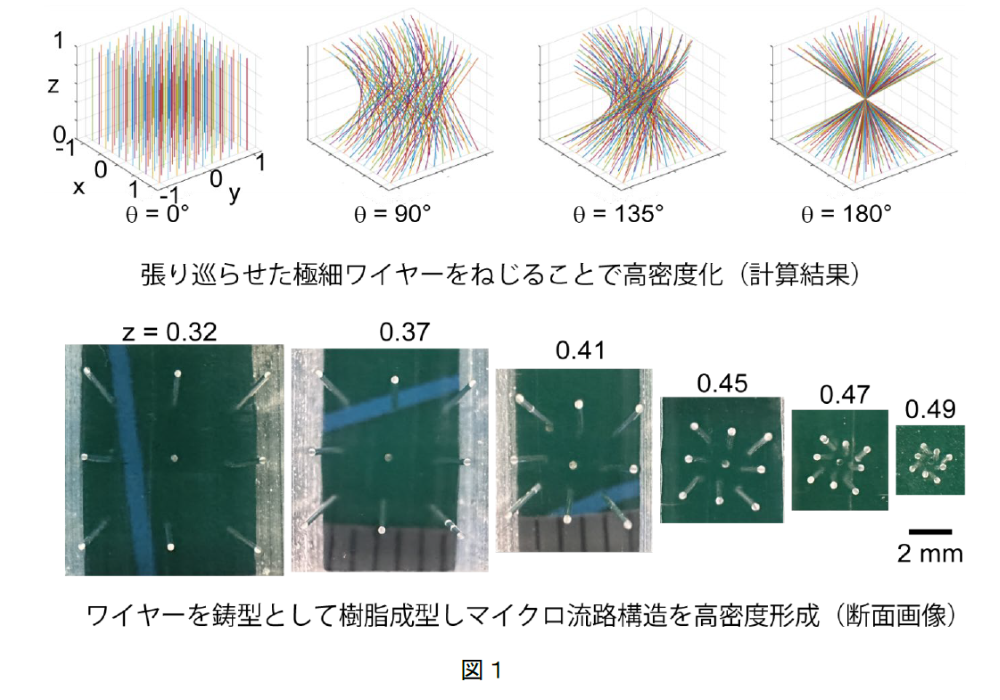
High-density two-dimensional (2D) micronozzle arrays with independently addressable microchannels are essential components for microfluidic probes, localized biochemical processing, and emerging micronozzle-based biofabrication systems. However, existing fabrication approaches typically rely on photolithography, multilayer stacking, or additive manufacturing, which can impose practical limitations in terms of fabrication complexity, scalability, and accessibility as micronozzle density increases. Here, we report a lithography-free fabrication method for high-density 2D micronozzle arrays based on a twisted thin-wire molding approach. By rotationally skewing thin sacrificial wires between two perforated plates and molding an elastomeric material, a dense wire arrangement is formed at a predefined plane. Sectioning at this plane yields closely packed micronozzle arrays with independent channel connectivity. Using 30 μm-diameter wire molds, a 4 × 4 micronozzle array was fabricated with an average aperture diameter of 35 μm and a center-to-center spacing of approximately 85 μm. Hydrodynamic flow confinement experiments demonstrated stable and parallel localized flow control, with confinement areas reduced to approximately 14% of those reported for multilayer-stacked microfluidic probes with a micronozzle array. The proposed approach provides a simple and scalable method for fabricating high-density micronozzle arrays and may facilitate broader adoption of advanced microfluidic probe architectures and nozzle-based biofabrication platforms.