2026-05-20 フランス国立科学研究センター(CNRS)
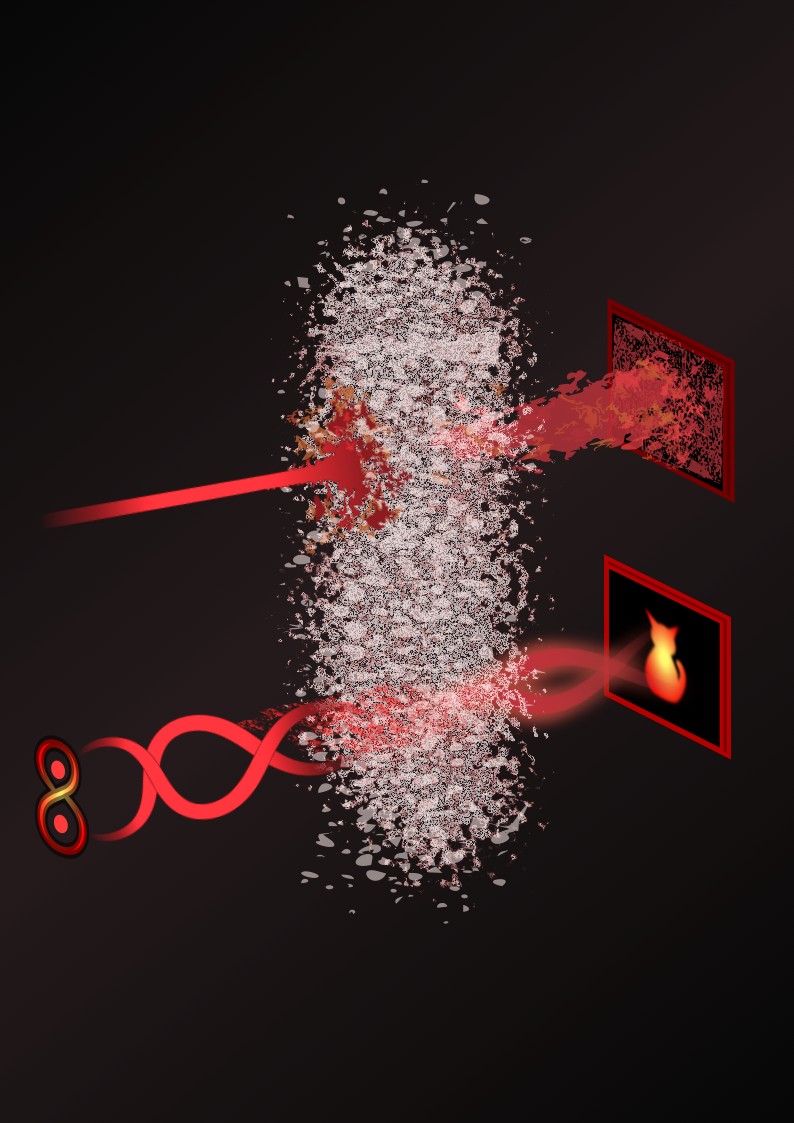
Illustration artistique de la transmission d’une image quantique à travers un milieu diffusant. © Chloé Vernière
<関連情報>
- https://www.cnrs.fr/en/press/rendering-opacity-transparent-through-quantum-entanglement
- https://www.nature.com/articles/s41567-026-03265-9
- https://opg.optica.org/optica/fulltext.cfm?uri=optica-13-5-968
複雑な媒体を介した量子もつれを利用した画像伝送 Entanglement-enabled image transmission through complex media
Chloé Vernière,Raphaël Guitter,Baptiste Courme & Hugo Defienne
Nature Physics Published:19 May 2026
DOI:https://doi.org/10.1038/s41567-026-03265-9
Abstract
Scattering in complex media scrambles light, thereby obscuring images and limiting applications from astronomy to microscopy. Existing computational and wavefront-shaping methods treat scattering as a linear optical-wave inversion problem that aims to render the medium transparent by inverting the scattering process. As classical approaches, they do not account for the quantum nature of the incident field. Here we demonstrate a quantum-entanglement-based method that enables selective image transmission through complex media. The medium is effectively turned into a quantum–classical image filter via wavefront shaping: images encoded on an entangled two-photon state are transmitted faithfully, whereas those carried by classical light remain fully scattered and unreadable. This method exploits a property of quantum entanglement—the preservation of photon correlations across multiple measurement bases—that has no classical counterpart. Therefore, we establish an approach for controlling light in complex media by tailoring solutions to the quantum properties of the input state, with potential applications in secure information transmission by rendering channels opaque to classical signals and preserving the quantum link.
複雑な媒質を介したエンタングルド光子の非古典的最適化 Non-classical optimization of entangled photons through complex media
Baptiste Courme, Chloé Vernière, Malo Joly, Daniele Faccio, Sylvain Gigan, and Hugo Defienne
Optica Published: May 18, 2026
DOI:https://doi.org/10.1364/OPTICA.583959
Abstract
Optimization approaches are ubiquitous in physics. In optics, they are key to manipulating light through complex media, enabling applications ranging from imaging to photonic simulators. In most demonstrations, however, the optimization process is implemented using classical coherent light, leading to a purely classical solution. Here, we introduce the concept of optical non-classical optimization in complex media. We experimentally demonstrate the control and refocusing of non-classical light—namely, entangled photon pairs—through a scattering medium by directly optimizing the output coincidence rate. Importantly, these optimal solutions cannot be obtained with classical light and do not result in a focus for classical light; this is a result of entanglement in the input state. This genuinely non-classical optimization method promises advances in quantum imaging, communication, and optical simulations with non-classical light.