
2026-10-30 琉球大学
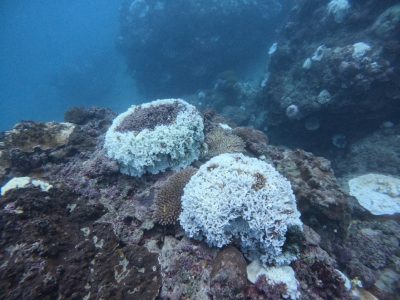
2025年11月に沖縄島南東部において確認されたサンゴ白化の様子
<関連情報>
日本の沖縄では、長期にわたる熱ストレスにより、例年の夏季期間を超えて前例のないサンゴの白化現象が発生している Prolonged thermal stress drives unprecedented coral bleaching beyond the typical summer period in Okinawa Island, Japan
Lucas Yutaka Kimura,Rickdane Gomez,Takashi Nakamura
Marine Ecology Progress Series
DOI:https://doi.org/10.3354/meps15273
Abstract
Anthropogenic climate change has intensified marine heatwaves, increasing coral bleaching events that typically occur during peak summer temperatures. While the magnitude and frequency of thermal stress have been widely studied as drivers of coral bleaching, the role of timing and duration of thermal stress in shaping bleaching outcomes remains understudied. Here, we investigated an unprecedented bleaching event that occurred beyond the 2025 summer season in Okinawa Island, Japan. Particularly, we focused on the timing and duration of thermal stress, spatiotemporal bleaching patterns, and coral genus-specific bleaching responses. Sea surface temperature (SST) and degree heating week (DHW) data were used to characterize thermal stress context, while multi-year coral monitoring from a permanent site and island-wide snapshot survey data were used to assess the spatiotemporal bleaching patterns. In 2025, SST exceeded the maximum monthly mean for 123 d, the longest recorded duration for Okinawa. Mean SST and DHW peaked in October at 30.24°C and 9.9°C-weeks, respectively, with Alert Level 1 conditions persisting until mid-December. Bleaching was spatially heterogeneous, with disproportionately high impacts along the central-southeastern coast. At highly impacted sites, bleaching severity was substantially higher in deeper zones, likely reflecting cumulative stress from prolonged thermal exposure and latent effects of the 2024 mass bleaching event. Genus-level responses further showed coral genera typically considered thermally tolerant exhibiting relatively high bleaching susceptibility. These findings demonstrate that despite lower magnitude, prolonged thermal stress can alter expected bleaching patterns, highlighting the importance of accounting for thermal stress timing and duration in future bleaching assessments.

