
2026-09-04 パシフィック・ノースウェスト国立研究所(PNNL)
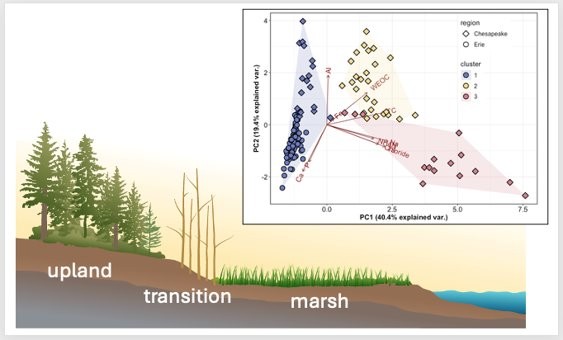
Surface soils were collected along a coastal transect. The Lake Erie soils were similar and formed a single cluster. The Chesapeake Bay soils were more variable, with upland and transition soils clustered together and marshes clustered together.
<関連情報>
- https://www.pnnl.gov/publications/transition-zones-shape-coastal-soil-chemistry-and-ecosystem-change
- https://agupubs.onlinelibrary.wiley.com/doi/10.1029/2025JG008978
変化する沿岸陸水境界における移行帯 Transition Zones at the Changing Coastal Terrestrial-Aquatic Interface
Kaizad F. Patel, Avni Malhotra, Cooper G. Norris, Sophia A. McKever, Devon M. Fields, Jared I. Musci, Sreejata Bandopadhyay, Ben Bond-Lamberty, Xingyuan Chen, Donnie J. Day …
Journal of Geophysical Research: Biogeosciences Published: 30 October 2025
DOI:https://doi.org/10.1029/2025JG008978
Abstract
Coastal soils are a significant but highly uncertain component of global biogeochemical cycles. These systems experience spatial and temporal variability in biogeochemical processes, driven by marsh-to-upland gradients and hydrological fluctuations. These fluctuations make it difficult to understand and predict biogeochemical processes in these highly dynamic systems. We studied coastal soil biogeochemistry and its variability (a) at regional scales and (b) across transects from upland forest to marsh, in two contrasting regions—Lake Erie, a freshwater lacustrine system, and Chesapeake Bay, a saltwater estuarine system. Salinity-related analytes were a key source of variability in soil biogeochemistry, not just in the saltwater system, but surprisingly, also in the freshwater system. We had hypothesized linear trends in biogeochemical parameters along the TAI—however, contrary to expectations, transition soils were not consistently intermediate between upland and marsh endmembers; the non-monotonic trends of C, P, Fe along our transects suggest that these do not behave as expected and may be difficult to model and predict—thus these are key analytes to study in our regions. Rapidly changing soil factors across coastal gradients (e.g., Ca, K, CEC, and TS) may act as precursors to ecosystem shifts. Our comprehensive soil characterization represents a snapshot of a single timepoint of surface soils and provides essential data for mechanistic modeling of ecosystem dynamics across coastal transects.

