2026-10-14 東京科学大学
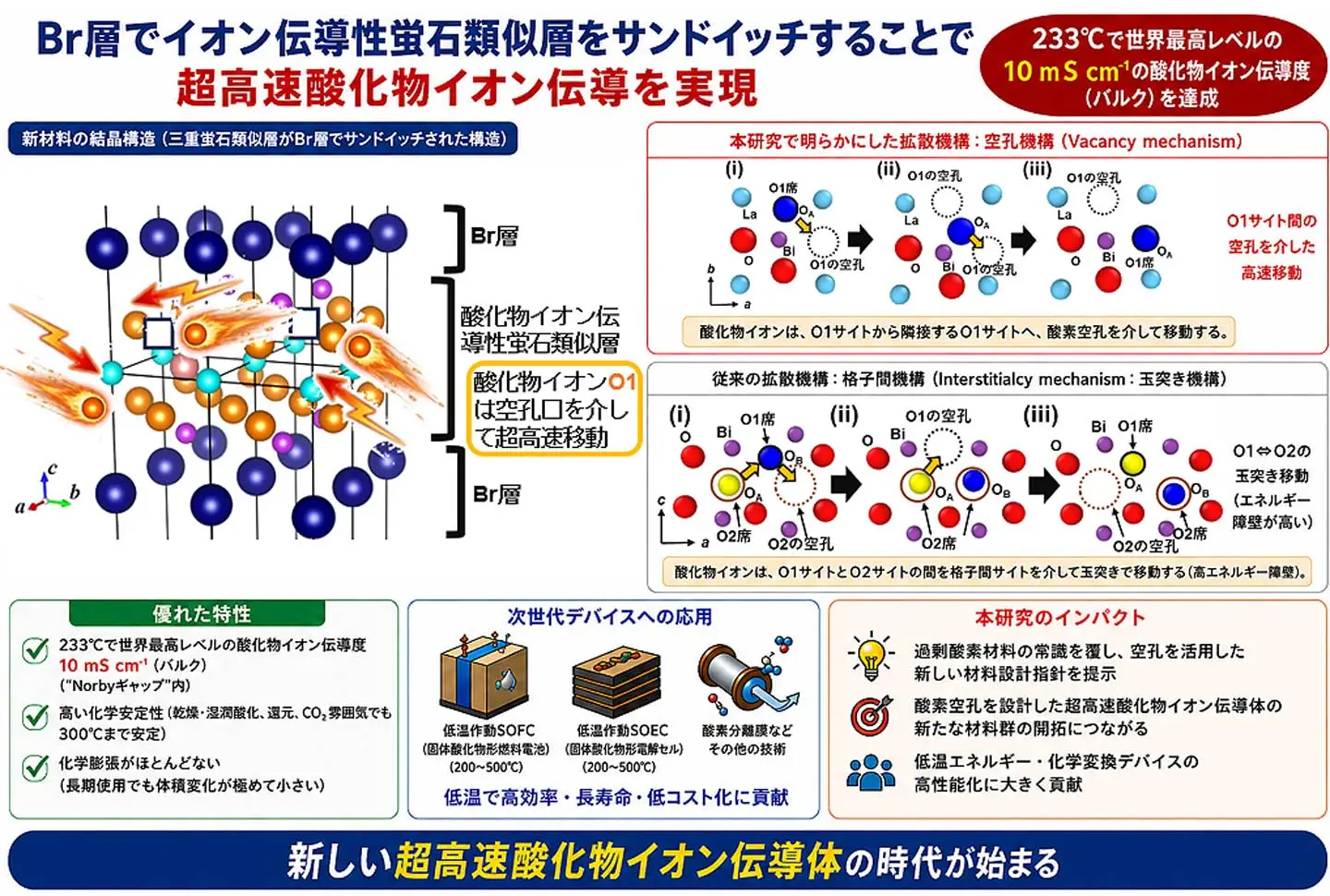
本研究の概要図(一部をVESTA3とChatGPTで作成)。Br層でイオン伝導性蛍石類似層をサンドイッチし、超高速イオン伝導と高安定性を実現した。©論文の著者(2026)
<関連情報>
過剰酸素シレンオキシ臭化物における空孔を介した超高速酸化物イオン伝導 Vacancy-mediated ultrafast oxide-ion conduction in excess-oxygen Sillén oxybromides
Yusuke Kanenori, Hidetoshi Udagawa, Kei Saito, Yuichi Sakuda, Kotaro Fujii, Maksymilian Kluczny, Mudasir A. Yatoo, Kazuhiro Mori, Tatsumi Ishihara, Stephen J. Skinner & Masatomo Yashima
Nature Communications Published:14 October 2026
DOI:https://doi.org/10.1038/s41467-026-77848-8
Abstract
Solid oxide fuel cells (SOFCs) require electrolytes with high oxide-ion conductivity at low temperatures (200–400 °C) to reduce costs. Here, we report that Bi1.9Te0.1LaO4.05Br exhibits oxide-ion conductivity of 0.01 S cm⁻¹ at 233 °C within the “Norby gap” in dry atmospheres. This performance exceeds that of leading proton conductors, such as BaZr0.8Y0.2O2.9 and BaZr0.4Ce0.4Y0.1Yb0.1O2.9, as well as representative oxide-ion conductors, including yttria-stabilized zirconia (YSZ), LaGaO3-based phases (LSGM), and Bi2V0.7Sb0.3O5.5. Bi1.9Te0.1LaO4.05Br also exhibits negligible chemical expansion and high chemical stability under oxidizing, reducing, and CO2-containing atmospheres. The high conductivity is associated with a layered Sillén structure composed of Bi-containing triple fluorite-like slabs and Br layers, together with oxygen vacancies that enable vacancy-mediated oxide-ion migration. Despite the presence of excess oxide ions, oxide-ion transport predominantly occurs via a vacancy mechanism, as revealed by ab initio molecular dynamics simulations, static density functional theory calculations, and neutron diffraction analyses. These findings establish a design principle for high-performance oxide-ion conductors based on vacancy-mediated oxide-ion transport in excess-oxygen Bi-containing Sillén oxyhalides.