2026-09-25 東北大学
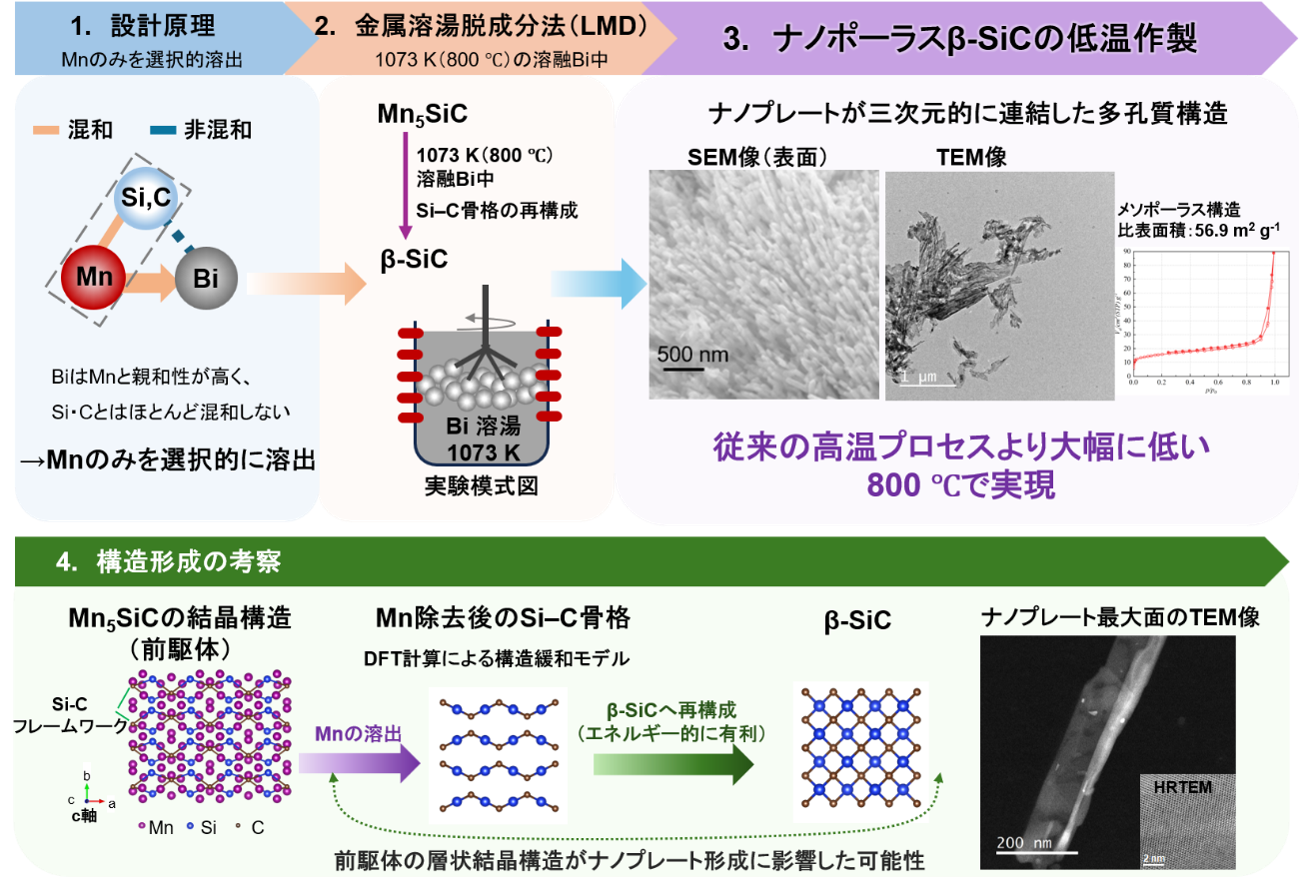
図1. 金属溶湯脱成分法によるナノポーラスβ-SiCの作製と構造形成の概念図。Mn5SiCからMnを選択的に除去することで、三次元的に連結したナノプレート構造を有するβ-SiCが形成されます。
<関連情報>
- https://www.tohoku.ac.jp/japanese/2026/09/press20260925-06-LMD.html
- https://www.sciencedirect.com/science/article/pii/S1359646226004070
液体金属脱合金化により、相互接続されたナノプレートネットワークを有するナノ多孔質β-SiCの低温合成が可能になる Liquid metal dealloying enables low-temperature synthesis of nanoporous β-SiC with an interconnected nanoplate network
Xiao Bian, Takeshi Wada, Hongyi Li, Ruirui Song, Mikihisa Fukuda, Nana Murata, Tetsu Ichitsubo, Hidemi Kato
Scripta Materialia Available online: 4 September 2026
DOI:https://doi.org/10.1016/j.scriptamat.2026.117570
Abstract
Developing an external-template-free route for synthesizing nanoporous covalent ceramics remains challenging because their strong covalent bonding typically necessitates high-temperature processing, which can limit nanoscale architectural control. Here, we report the fabrication of three-dimensional nanoscale bicontinuous porous β-SiC (3Dnbp-β-SiC) at 1073 K through a top-down metallurgical route based on liquid metal dealloying. During this process, a Mn5SiC precursor with a layered crystal structure was immersed in molten Bi, where Mn was selectively dissolved while the residual Si–C framework self-organized into crystalline β-SiC. Unlike the nearly isotropic ligament networks commonly observed in conventional dealloying systems, the product comprises a bicontinuous porous architecture constructed from interconnected nanoplates and exhibits a mesoporous structure with a BET surface area of 56.9 m2 g−1. These results highlight liquid metal dealloying as a viable metallurgical strategy for fabricating nanoporous covalent ceramics at a relatively low temperature.