2026-08-24 東北大学
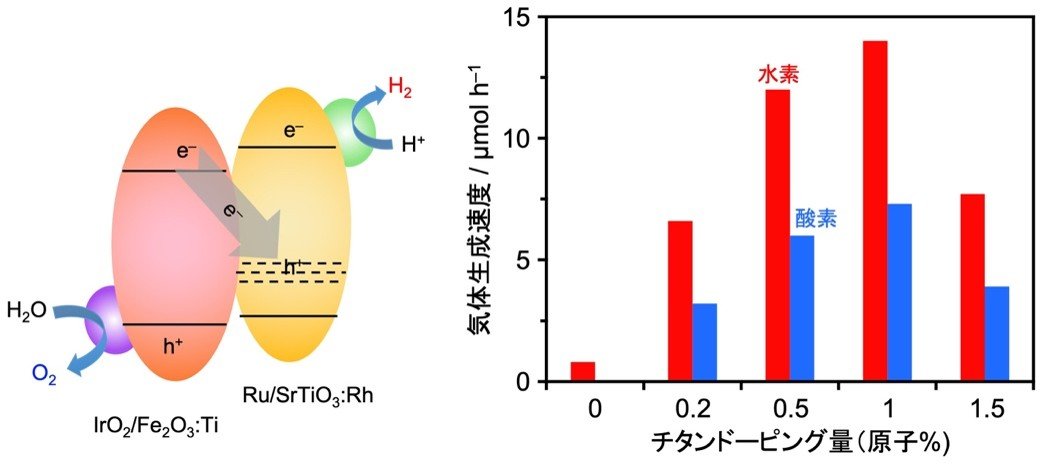
図1. チタンドーピング量を変えた酸化鉄とロジウムドープチタン酸ストロンチウムを組み合わせたZスキーム型光触媒の水分解に対する活性
<関連情報>
- https://www.tohoku.ac.jp/japanese/2026/08/press20260824-01-Fe2O3.html
- https://pubs.acs.org/aaemcq/article/9/16/10519/5250124/Z-Scheme-Water-Splitting-Utilizing-Fe2O3-as-an
Fe2O3を酸素発生光触媒として利用したZスキーム型水分解 Z-Scheme Water Splitting Utilizing Fe2O3 as an Oxygen-Evolving Photocatalyst
Tomoomi Miyashita;Shunya Yoshino;Makoto Kobayashi;Hideki Kato
ACS Applied Energy Materials Published:August 07, 2026
DOI:https://doi.org/10.1021/acsaem.6c01486
Abstract
Fe2O3 is a widely studied material as a photoanode and O2 evolution photocatalyst responsive to visible light. Although Z-scheme systems employing Fe2O3-based photocatalysts have been reported, the kind of combined H2-evolving photocatalyst is limited to C3N4. In this study, we demonstrated water splitting by the Z-scheme systems utilizing Ti-doped Fe2O3 (Fe2O3:Ti) and Rh-doped SrTiO3 (SrTiO3:Rh). Z-scheme water splitting (Z-WS) was achieved by the interparticle electron transfer from Fe2O3:Ti to SrTiO3:Rh. Ti doping was essential to achieve Z-WS. Doping Ti into Fe2O3 increased the carrier density, causing improvement of electronic conductivity and enhancement of charge separation through band bending. These factors remarkably improved the photoelectrochemical property, resulting in achievement of Z-WS. The Ru/SrTiO3:Rh-Fe2O3:Ti system was active for water splitting even without cocatalyst modification of Fe2O3:Ti. The activity was improved by the IrOx deposition, while modification with MnOx, FeOx, CoOx, and RhOx decreased activity. The impregnation method involving heat treatment at 500–600 °C and the adsorption method followed by heat treatment at 500 °C were found to be an appropriate condition for IrOx deposition through systematic characterization. The external quantum yield of the present system was determined to be 0.23% at 430 nm.