2026-10-15 東京科学大学
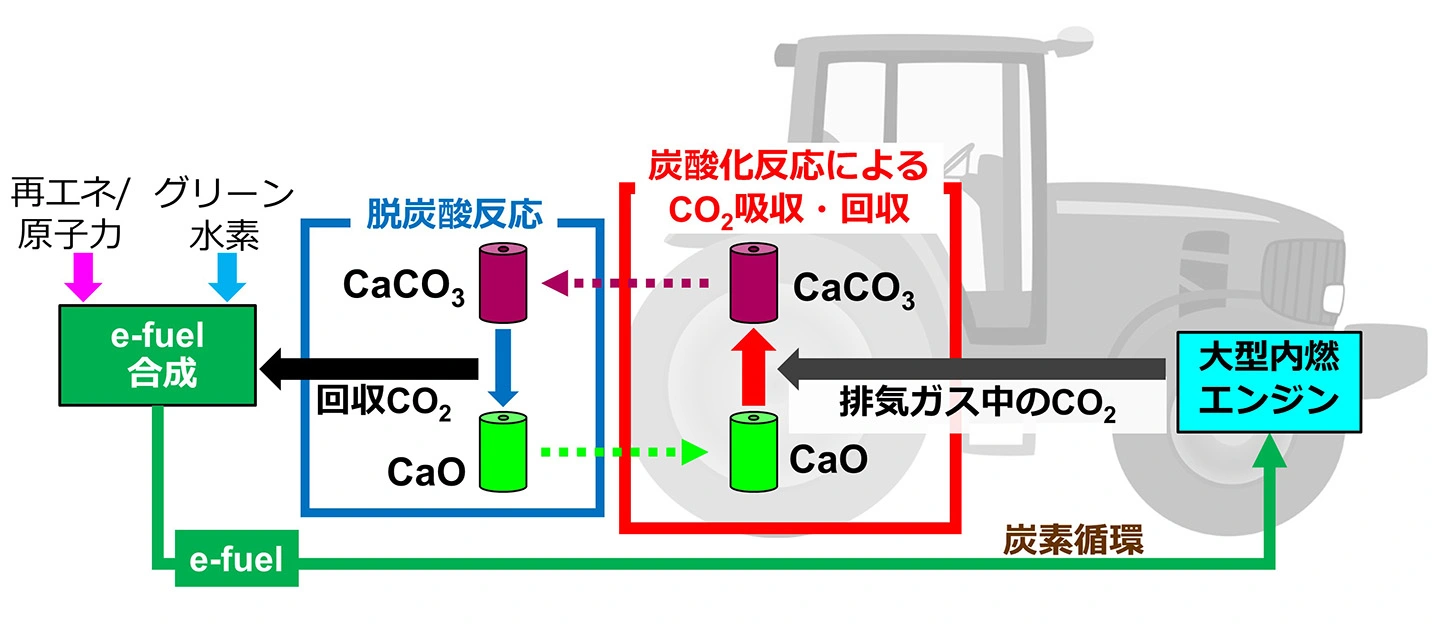
図1. 移動体向け炭素循環エネルギーシステム(vACRES)
<関連情報>
- https://www.isct.ac.jp/ja/news/2aqlwmai4p6
- https://www.sciencedirect.com/science/article/abs/pii/S138589472608174X
炭化ケイ素系フォーム上に支持された高耐久性酸化カルシウム複合材料の二酸化炭素捕捉性能 Carbon dioxide capture performance of a highly durable calcium oxide composite supported on silicon carbide-based foam
Kenta Tomita, Shigehiko Funayama, Tsuyoshi Izaki, Xiaoyu Chen, Hiroki Takasu, Yukitaka Kato
Chemical Engineering Journal Available online: 13 August 2026
DOI:https://doi.org/10.1016/j.cej.2026.180712
Highlights
- A CaO-based composite comprising MgO and SiSiC foams for CO2 capture is developed.
- The composite exhibits an improved cycle reactivity of 33% after 30 cycles.
- The composite has high bulk stability with minimal volume change after 30 cycles.
- The SiSiC foam reduces CaO/CaCO3 sintering and retains the specific surface area.
- The composite achieves an effective thermal conductivity of up to 1.1 W m−1 K−1.
Abstract
Calcium oxide (CaO) is a promising material for carbon dioxide (CO2) capture owing to its wide availability and low cost. However, CaO and calcium carbonate (CaCO3) suffer from progressive loss of reactivity during cycling due to sintering at high temperatures, volume changes, and low thermal conductivity. In this study, we aimed to overcome these limitations of pure CaO by developing a novel composite comprising a MgO-added CaO sorbent and silicon-infiltrated silicon carbide (SiSiC) foam as a macro-structural support. We fabricated composite blocks with a total mass of ~43 g and evaluated them over repeated decarbonation‑carbonation cycles in a laboratory-scale fixed-bed reactor. After 30 cycles, the composite exhibited 33% higher cyclic reactivity compared with a reference MgO-added CaO block. Surface observations revealed that MgO in the composite remained uniformly dispersed after cycling, and the composite exhibited a substantially higher specific surface area than the reference material, indicating suppressed CaO/CaCO3 sintering. In addition, unlike the reference block that had shrunk and was severely damaged, the composite showed little volume change after 30 cycles. These results suggest that the rigid reticulate structure of the SiSiC foam, with small pores that partition the CaO phase, simultaneously mitigates composite shrinkage and inhibits CaO particle growth due to sintering during cycling. Furthermore, the composite exhibited high thermal conductivities of up to 1.1 W m−1 K−1, approximately 10-fold higher than that of the reference material. These results demonstrate that the thermally conductive, highly durable composite developed in this study is a practical material for CO2 capture applications.