
2026-10-14 マサチューセッツ工科大学(MIT)
<関連情報>
- https://news.mit.edu/2026/researchers-improve-weather-forecasts-looking-two-six-weeks-out-1014
- https://www.nature.com/articles/s41586-026-11126-x
機械学習による季節内予測の進歩 Advancing subseasonal forecasting with machine learning
Hannah Guan, Soukayna Mouatadid, Paulo Orenstein, Judah Cohen, Haiyu Dong, Zekun Ni, Jeremy Berman, Genevieve Flaspohler, Alex Lu, Jakob Schloer, Joshua Talib, Jonathan A. Weyn & Lester Mackey
Nature Published:14 October 2026
DOI:https://doi.org/10.1038/s41586-026-11126-x
Abstract
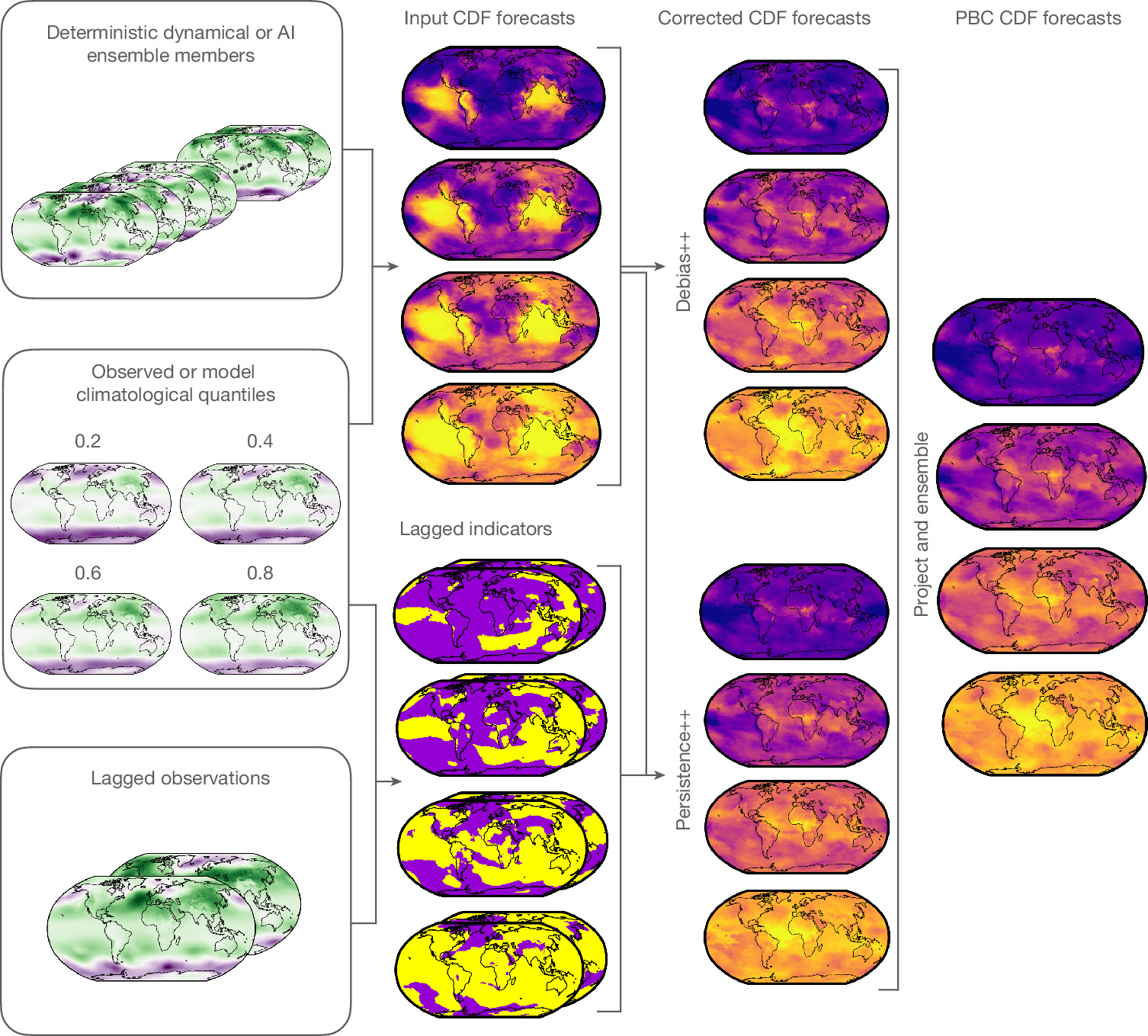
Decision-makers rely on weather forecasts to plant crops, manage wildfires, allocate water and energy and prepare for weather extremes1,2,3. Today, such forecasts enjoy unprecedented accuracy as far as 2 weeks thanks to steady advances in physics-based dynamical models and data-driven artificial intelligence models4,5,6,7,8,9,10. However, model skill drops precipitously at subseasonal timescales (2–6 weeks ahead) due to compounding errors, systemic model biases and the chaotic nature of the atmosphere11,12,13,14,15. To counter this degradation, we introduce probabilistic bias correction, a machine learning framework that substantially reduces systematic error by learning to correct historical probabilistic forecasts. When applied to the leading dynamical and artificial intelligence models from the European Centre for Medium-Range Weather Forecasts (ECMWF), probabilistic bias correction doubles the modest subseasonal skill of the AI Forecasting System16 and improves the skill of the operationally debiased dynamical model17 for 91% of pressure, 92% of temperature and 98% of precipitation targets. We designed probabilistic bias correction for operational deployment, and, in the 2025 real-time forecasting competition of ECMWF18, its global forecasts were the best for all weather variables and lead times, outperforming the dynamical models from six operational forecasting centres, an international dynamical multimodel ensemble, the AI Forecasting System of ECMWF and the forecasting systems of 34 teams worldwide. These probabilistic skill gains translate into more accurate prediction of extreme events and have the potential to improve agricultural planning, energy management and disaster preparedness in vulnerable communities19.

