2026-10-08 自然科学研究機構・アルマ望遠鏡
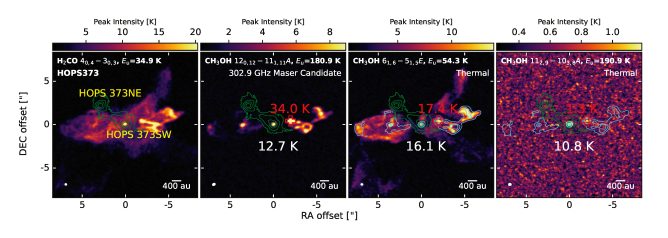
図1:COMPASSで観測された原始星の一つ HOPS 373 のアルマ望遠鏡による電波画像。(Jeong et al. の図1をもとに作成)
<関連情報>
- https://alma-telescope.jp/news/urbeacons-202610.html
- https://www.aanda.org/articles/aa/full_html/2026/10/aa58725-25/aa58725-25.html
- https://www.aanda.org/articles/aa/full_html/2026/10/aa58751-25/aa58751-25.html
- https://www.aanda.org/articles/aa/full_html/2026/10/aa58733-25/aa58733-25.html
- https://www.aanda.org/articles/aa/full_html/2026/10/aa58748-25/aa58748-25.html
- https://www.aanda.org/articles/aa/full_html/2026/10/aa58732-25/aa58732-25.html
- https://www.aanda.org/articles/aa/full_html/2026/10/aa58734-25/aa58734-25.html
- https://www.aanda.org/articles/aa/full_html/2026/10/aa59642-26/aa59642-26.html
アルマ分光観測による原始星中の複雑な有機分子の探査(COMPASS) I. ALMA大規模プログラムの概要 Complex Organic Molecules in Protostars with ALMA Spectral Surveys (COMPASS) I. Overview of the ALMA Large Program
J. K. Jørgensen, A. Coutens, M. N. Drozdovskaya, J.-E. Lee, A. L. Plunkett, S. Maret, A. Belloche, D. Harsono, Z. Telkamp, F. Cruz-Sáenz de Miera, M. L. R. van ’t Hoff, Á. Kóspál, M. Rao, J. Bergner, J.-H. Jeong, S. Spezzano, B. A. McGuire,, P. Nazari, Y.-L. Yang, H.-S. Yun, A. Andreu, J. Ferrer Asensio, C.-H. Kim, N. F. W. Ligterink, Y. Lin, S.-Y. Liu, M. Lützen, P. Marchand, C. Xue and S. Zeng
Astronomy & Astrophysics Published:07 October 2026
DOI:https://doi.org/10.1051/0004-6361/202558725
Abstract
Context. It remains a fundamental research question in astrochemistry to characterize the inventory of complex organic molecules formed during the early stages of star formation, which may affect the eventual chemical composition of protoplanetary disks and potentially planets. So far, only studies of individual sources or selected samples of molecular species have been conducted and the relative importance of environmental and evolutionary effects on the chemical composition remains unclear.
Aims. The Atacama Large Millimeter/submillimeter Array (ALMA) provides the angular resolution and sensitivity to zoom in on the hot (T > 100 K) gas surrounding embedded solar-type protostars and chart their molecular inventories with high accuracy. The ALMA Large Program Complex Organic Molecules in Protostars with ALMA Spectral Surveys (COMPASS) aims to provide comprehensive inventories of the molecular content of a sample of protostellar sources to understand the chemical impact of their environments and evolutionary stages.
Methods. COMPASS is an unbiased spectral survey of 11 line-rich Class 0 and I protostellar sources in the spectral range from 279.0 to 311.7 GHz at 0.15–0.5″ angular resolution with ALMA, corresponding to the inner ∼100 au (radius) around the targeted sources. Through this survey, unique chemical fingerprints of each source can be established.
Results. This paper provides an overview of the COMPASS program and the adopted strategy in terms of observational setups and targeted sources. We also present a qualitative comparison of the spatial distributions of selected molecules and the relative strengths of the line fluxes of selected complex organics.
Conclusions. The qualitative comparisons suggest that chemical differences between sources may be present, for example, between the abundances of groups of oxygen- and nitrogen-bearing species, but also that such variations occur at levels smaller than an order of magnitude. Quantitative comparisons of abundances at these levels require the large bandwidth of the survey, as well as a careful analysis of the excitation and strengths of the several thousands of lines detected toward each source in the survey, as will be explored in forthcoming papers.
アルマ分光観測による原始星中の複雑な有機分子の探査(COMPASS) II. 線スペクトルが豊富な広帯域(サブ)ミリ波スペクトルのデータ削減と成果物へのアプローチ Complex Organic Molecules in Protostars with ALMA Spectral Surveys (COMPASS) II. Approach to data reduction and products for line-rich broadband (sub)millimeter spectra
Adele L. Plunkett, Sébastien Maret, Daniel Harsono, Jes K. Jørgensen, Audrey Coutens, Maria N. Drozdovskaya, Jeong-Eun Lee, Arnaud Belloche, Fernando Cruz-Sáenz de Miera, Merel L. R. van ’t Hoff, Jae-Hong Jeong, Chul-Hwan Kim, Ágnes Kóspál, Martine Lützen, Brett A. McGuire, Pooneh Nazari, Silvia Spezzano, Zoie Telkamp, Yao-Lun Yang, Hyeong-Sik Yun,, Audrey Andreu, Jennifer Bergner, Judit Ferrer Asensio, Niels F. W. Ligterink, Yuxin Lin, Sheng-Yuan Liu, Pierre Marchand, Mihika Rao and Shaoshan Zeng
Astronomy & Astrophysics Published:07 October 2026
DOI:https://doi.org/10.1051/0004-6361/202558751
Abstract
Context. Studying the chemical composition of the warm gas surrounding embedded solar-type protostars is one of the areas for which the Atacama Large Millimeter/submillimeter Array (ALMA) is particularly well suited. Recently, the ALMA Large Program Complex Organic Molecules in Protostars with ALMA Spectral Surveys (COMPASS) carried out an observing campaign of a sample of 11 protostellar regions to investigate the chemical impact of their environments and evolutionary stages.
Aims. The aim of this paper is to provide the observational and procedural information necessary for the community to understand the analysis presented in forthcoming scientific papers by the COMPASS collaboration, and to enable archival research using the data products provided by our team and the ALMA Science Archive.
Methods. This paper describes the technical setup of the observations, and it outlines the data-processing pipeline and primary data products from this initiative. The Common Astronomy Software Applications (CASA) was used for initial calibration following the standard ALMA Pipeline, and then IMAGER was used for self-calibration and imaging. We describe post-processing done with Python to achieve favorable continuum subtraction, correct for the primary beam response, and extract spectra.
Results. We discuss our strategy for mitigating data challenges, including those related to data volume and continuum subtraction for spectral line analysis. The incorporation of IMAGER in our workflow was advantageous in terms of the computing efficiency which allowed us to benchmark several imaging parameters and techniques; we also demonstrate that the imaging outcomes using IMAGER or CASA are scientifically comparable. Numerous data products are generated for the program, including image cubes for the 36 spectral windows targeting each source, extracted spectra, and continuum images.
アルマ分光観測による原始星中の複雑な有機分子の探査(COMPASS) III.低質量原始星BHR71-IRS1におけるCH₃OH同位体分別 Complex Organic Molecules in Protostars with ALMA Spectral Surveys (COMPASS) III. CH3OH isotopic fractionation in the low-mass protostar BHR71-IRS1
A. Coutens, F. Cruz-Sáenz de Miera, J. K. Jørgensen, M. N. Drozdovskaya, J.-E. Lee, A. L. Plunkett, D. Harsono, S. Maret, A. Belloche, J. Ferrer Asensio, M. L. R. van’t Hoff, J.-H. Jeong, Á. Kóspál, B. A. McGuire,, P. Nazari, S. Spezzano, Z. Telkamp, Y.-L. Yang, H.-S. Yun, S. Zeng, A. Andreu, J. Bergner, C.-H. Kim, N. F. W. Ligterink, Y. Lin, S.-Y. Liu, M. Lützen, P. Marchand and M. Rao
Astronomy & Astrophysics Published:07 October 2026
DOI:https://doi.org/10.1051/0004-6361/202558733
Abstract
Context. Methanol is a complex organic molecule detected in both ice and gas toward star-forming regions. Due to its high abundance, its rarer isotopologues, including the deuterated ones, are also commonly detected. Measurements of deuteration can provide key constraints on the formation and evolution of molecules during the formation of stars and planets. It is not clear how the methanol deuteration varies between star-forming regions. Thanks to several recent spectroscopic studies, it is now possible to precisely derive the column densities of five deuterated isotopologues of methanol.
Aims. Our aim is to determine the column density and deuterium fractionation of methanol in the low-mass protostar BHR71-IRS1.
Methods. We analyzed data from a large spectral survey of BHR71-IRS1 carried out as part of the ALMA Large Program Complex Organic Molecules in Protostars with ALMA Spectral Surveys (COMPASS). We used the CASSIS software to identify the lines of the methanol isotopologues and constrain their column densities under the assumption of local thermodynamic equilibrium.
Results. We detected CH3OH, 13CH3OH, CH318OH, CH3OD, CH2DOH, CHD2OH, and CD3OH at the continuum peak position. In addition, CH317OH is tentatively detected, while CD3OD is not detected, although a few faint lines (≲3σ) could be present toward a position redshifted from the continuum peak. The column densities of the main isotopologue obtained from 13CH3OH and CH318OH are consistent, assuming nominal 12C/13C and 16O/18O ratios of 68 and 557, respectively. The CH2DOH/CH3OD column density ratio is equal to 7 ± 2. The statistically corrected D/H ratio is higher for CH2DOH (1.9 ± 0.6%) than for CH3OD (0.8 ± 0.2%). The level of deuteration after statistical correction increases with the number of D atoms in the methyl group, reaching 23 ± 5% for CD3OH/CH3OH.
Conclusions. These trends are similar to other low-mass protostars such as IRAS 16293–2422 and HOPS 373SW, but seem to differ from the eruptive young star V883-Ori. Similar studies with comparable datasets will be carried out for the other COMPASS sources to determine if factors such as environmental conditions and evolutionary states impact the deuteration of methanol.
アルマ分光観測による原始星中の複雑な有機分子の探査(COMPASS) IV. BHR71-IRS1に対するメチルシアン化物同位体 Complex Organic Molecules in Protostars with ALMA Spectral Surveys (COMPASS) IV. Methyl cyanide isotopologues toward BHR71-IRS1
P. Nazari, A. Coutens, J. K. Jørgensen, A. Belloche, A. L. Plunkett, S. Maret, D. Harsono, M. N. Drozdovskaya, J.-E. Lee, F. Cruz-Sáenz de Miera, J. Ferrer Asensio, M. L. R. van ’t Hoff, J.-H. Jeong, Á. Kóspál, B. A. McGuire,, S. Spezzano, Y.-L. Yang, H.-S. Yun and S. Zeng
Astronomy & Astrophysics Published:07 October 2026
DOI:https://doi.org/10.1051/0004-6361/202558748
Abstract
Context. Methyl cyanide (CH3CN) is one of the most abundant nitrogen-bearing complex organic molecules observed in the gas phase around both low- and high-mass protostars. However, very few observations exist with a broad enough frequency coverage and sufficiently high sensitivity to systematically characterize its minor isotopologues toward such regions.
Aims. We add to this number by analyzing data toward BHR71-IRS1 taken with the Atacama Large Millimeter/submillimeter Array (ALMA) as part of the Complex Organic Molecules in Protostars with ALMA Spectral Surveys (COMPASS) Large Program over a ∼33 GHz frequency range.
Methods. We studied as many isotopologues of methyl cyanide as possible toward BHR71-IRS1. We found the column densities and excitation temperatures via spectral fitting and assuming local thermodynamic equilibrium. We then compared the derived column density ratios with those toward IRAS 16293-2422 A and B, V883 Ori, G31.41+0.31, and Sgr B2(N2b).
Results. We detect CH3CN, CH3CN v8=1, 13CH3CN, CH313CN, CH3C15N, CH2DCN, and CHD2CN. The column density ratio of 13CH3CN/CH313CN is around unity, in agreement with previous observations. The CH2DCN/CH3CN ratios are similar for all the low-mass objects but are ∼1 order of magnitude higher than those toward Sgr B2(N2b). This could be due to a warmer pre-stellar phase or a different formation timescale of Sgr B2(N2b).
Conclusions. The D/H ratios found from methyl cyanide isotopologues agree well with those of methanol toward BHR71-IRS1, likely pointing to the formation and deuteration of methyl cyanide in a similar star-formation phase as methanol (i.e., the pre-stellar phase). We find an increase in the methyl cyanide D/H ratios with the number of deuterium atoms, which suggests that the deuterated isotopologues may form later in the pre-stellar phase. Future COMPASS studies will increase the sample size of low-mass systems with methyl cyanide analysis and potentially examine some of the trends observed here statistically.
アルマ分光観測による原始星中の複雑な有機分子の探査(COMPASS) V. BHR71-IRS1における非熱脱着CH₃OHを用いた空洞壁と衝撃を受けた結び目の追跡 Complex Organic Molecules in Protostars with ALMA Spectral Surveys (COMPASS) V. Tracing cavity walls and shocked knots with nonthermally desorbed CH3OH in BHR71-IRS1
H.-S. Yun, J.-E. Lee,, J. K. Jørgensen, A. Coutens, A. L. Plunkett, M. N. Drozdovskaya, A. Belloche, J.-H. Jeong, P. Nazari, Y.-L. Yang, M. L. R. van ’t Hoff, S. Maret, F. Cruz-Sáenz de Miera, D. Harsono, C.-H. Kim, Á. Kóspál, M. Lützen, S. Spezzano and S. Zeng
Astronomy & Astrophysics Published:07 October 2026
DOI:https://doi.org/10.1051/0004-6361/202558732
Abstract
Context. Complex organic molecules (COMs) are detected in the interstellar medium, both in cold molecular clouds and in the warm inner regions of protostars. Whether these COMs are eventually directly inherited by protostars and planets or whether their chemistry is reset by in situ reactions remains unclear. Recent (sub)millimeter wavelength observations have spatially resolved the emission of gas-phase COMs around low-mass protostars, not only in compact hot corinos but also in the extended structures beyond them. Understanding the physical properties and desorption mechanisms of these molecules is essential for tracing their chemical evolution during the protostellar evolutionary sequence. Methanol (CH3OH), the most abundant COM in star-forming regions, serves as an ideal tracer for investigating these processes.
Aims. As part of the ALMA Cycle 9 Large Program Complex Organic Molecules in Protostars with ALMA Spectral Surveys (COMPASS), we investigate the CH3OH emission that extends beyond the hot corino of the low-mass protostar BHR71-IRS1.
Methods. We identified spatially extended emission of CH3OH around BHR71-IRS1 and subsequently explored plausible desorption scenarios. We assessed characteristic emission structures by applying a principal component analysis (PCA) to the identified emission lines. The physical properties of their line-emitting gas were derived under the local thermodynamic equilibrium (LTE) assumption through both rotational diagram and spectral modeling analyses.
Results. In total, 26 spatially extended CH3OH lines have been detected around BHR71-IRS1. These emission lines are distributed across three distinct structures: (1) X-shaped cavity walls, (2) compact northern and southern shocked knots, and (3) additional distant eastern and southeastern components. The cavity walls exhibit excitation temperatures of ∼25 K and column densities of ∼1014 cm−2, while the knots show relatively higher excitation temperatures (70–120 K) and column densities (1014–1016 cm−2). The eastern and southeastern components appear unrelated to BHR71-IRS1, and their physical properties are not well constrained under LTE conditions, suggesting that a non-LTE analysis may be required.
Conclusions. Plausible desorption mechanisms are evaluated by comparing the physical parameters with model predictions that simulated the effects of far-ultraviolet (FUV) photons and C-type shocks. The low excitation temperatures and narrow line widths (∼0.7 km s−1) in the cavity walls favor a reactive desorption scenario driven by FUV irradiation from IRS1. In contrast, the knots with higher excitation temperatures and column densities support the dust sputtering scenario induced by C-type shocks.
アルマ分光観測による原始星中の複雑な有機分子の探査(COMPASS) VI. クラスIメタノールメーザー遷移の発見とアセトアルデヒドとの関連性 Complex Organic Molecules in Protostars with ALMA Spectral Surveys (COMPASS) VI. Discovery of a class I methanol maser transition and its association with acetaldehyde
Jae-Hong Jeong, Jeong-Eun Lee, Jes K. Jørgensen, Audrey Coutens, Maria N. Drozdovskaya, Adele L. Plunkett, Arnaud Belloche, Sébastien Maret, Hyeong-Sik Yun, Fernando Cruz-Sáenz de Miera, Daniel Harsono, Merel L. R. van ’t Hoff, Chul-Hwan Kim, Ágnes Kóspál, Brett A. McGuire, Pooneh Nazari, Silvia Spezzano, Yao-Lun Yang and Shaoshan Zeng
Astronomy & Astrophysics Published:07 October 2026
DOI:https://doi.org/10.1051/0004-6361/202558734
Abstract
Context. Methanol (CH3OH) masers that are collisionally pumped, referred to as ‘class I’, commonly trace shock interfaces in star-forming regions, but their incidence in embedded low-mass protostars remains poorly quantified.
Aims. We aim to (i) establish the occurrence, spatial origin, and excitation of a newly detected class I CH3OH maser at 302.913 GHz (120,12–111,11A, Eu = 180.9 K) towards low-mass protostars and (ii) test whether the environments that pump this maser exhibit signatures of shock-driven complex chemistry.
Methods. We utilised data from the COMPASS ALMA Large Program to search for maser activity in the 302.9 GHz line in a sample of 11 low-mass protostellar sources. The COMPASS programme provides unbiased surveys of these sources between 279.0 and 311.7 GHz covering several transitions of CH3OH as well as other complex organic molecules (COMs) at typical angular resolutions of 0.″3 − −0.″5. Measuring departures from local thermodynamic equilibrium (LTE) in the 302.9 GHz CH3OH excitation via rotation diagram analysis robustly revealed masing.
Results. The 302.9 GHz CH3OH line is detected as a non-thermal excess (maser) in seven out of 11 COMPASS sources, with peak brightness temperatures ranging from a few to a thousand kelvin. One of these detections is towards HOPS 108, which hosts the brightest maser, and it is likely associated with the powerful outflow driven by the nearby intermediate-mass protostar HOPS 370. Excluding this case, the maser is detected in six of the ten low-mass protostars (60%). All six low-mass protostars in which maser emission is detected are Class 0 sources interacting with dense ambient material, whereas non-detections correspond to three Class I objects and one isolated Class 0 core. This indicates a preference for early evolutionary stages and environments rich in gas for outflow–ambient medium interactions. The maser emission is spatially coincident with thermal CH3OH emission along the outflow cavity walls and bow shocks, but it has more compact knot-like morphologies. Lastly, among the surveyed COMs, only acetaldehyde (CH3CHO) closely traces the shocked morphology of the 302.9 GHz CH3OH maser. However, this CH3CHO feature is observed only towards the brightest maser in the region around HOPS 108, which is influenced by the intermediate-mass protostellar outflow.
Conclusions. Our study reveals that class I CH3OH masers in low-mass protostellar systems are more prevalent than previously recognised and preferentially occur in younger, more embedded systems. Although this has only been observed in an intermediate-mass protostellar outflow, CH3CHO is enhanced in a manner consistent with shock-driven chemistry along the outflow cavities. Testing whether a similar relationship applies in the low-mass regime will require more sensitive CH3CHO observations towards regions where the class I CH3OH masers are detected.
アルマ分光観測による原始星中の複雑な有機分子の探査(COMPASS) VII.星間空間における完全重水素化メタノールの初検出 Complex Organic Molecules in Protostars with ALMA Spectral Surveys (COMPASS) VII. First interstellar detection of fully deuterated methanol
A. Belloche, S. Spezzano, A. Coutens, M. N. Drozdovskaya, J. K. Jørgensen, J.-E. Lee, A. L. Plunkett, D. Harsono, S. Maret, F. Cruz-Sáenz de Miera, J.-H. Jeong, P. Nazari, Y.-L. Yang, H.-S. Yun and S. Zeng
Astronomy & Astrophysics Published:07 October 2026
DOI:https://doi.org/10.1051/0004-6361/202659642
Abstract
Context. There have been no robust identifications of fully deuterated methanol, CD3OD, in the interstellar medium (ISM) to date.
Aims. Our goal is to continue the search for CD3OD in star-forming regions to determine the deuteration pattern of methanol and set constraints on the deuteration process.
Methods. We used a sensitive imaging spectral survey of the protostellar system IRAS4A in the NGC1333 molecular cloud performed as part of the large program carried out with the Atacama Large Millimeter/submillimeter Array (ALMA) called Complex Organic Molecules in Protostars with ALMA Spectral Surveys (COMPASS). The column densities of methanol and several of its less abundant isotopologs, including deuterated ones, were derived under the assumption of local thermodynamic equilibrium (LTE).
Results. Along with the detection of several methanol isotopologs toward the binary component IRAS4A2, we report the first interstellar detection of CD3OD. The deuteration pattern of methanol in IRAS4A2 is similar to the pattern measured in other low-mass protostars, with an increase in the apparent D/H ratio from the singly to multiply deuterated isotopologs. Chemical models of prestellar and protostellar cores focused on deuteration do not reproduce this pattern quantitatively. This discrepancy is even more exacerbated by the detection of CD3OD. Our LTE modeling of the spectra yields low column density ratios of methanol to its 13C and 18O isotopologs while the 13C to 18O and 18O to 17O ratios are consistent with the isotopic ratios expected in the local ISM. We suspect that the column density of methanol is underestimated. One possible explanation is that the emission is clumpy rather than monolithic.
Conclusions. The first detection of a fully deuterated COM highlights the power of deuterium fractionation as a diagnostic tool for investigating the formation and inheritance of organic molecules during the process of star formation.