2026-10-06 国立天文台・野辺山宇宙電波観測所

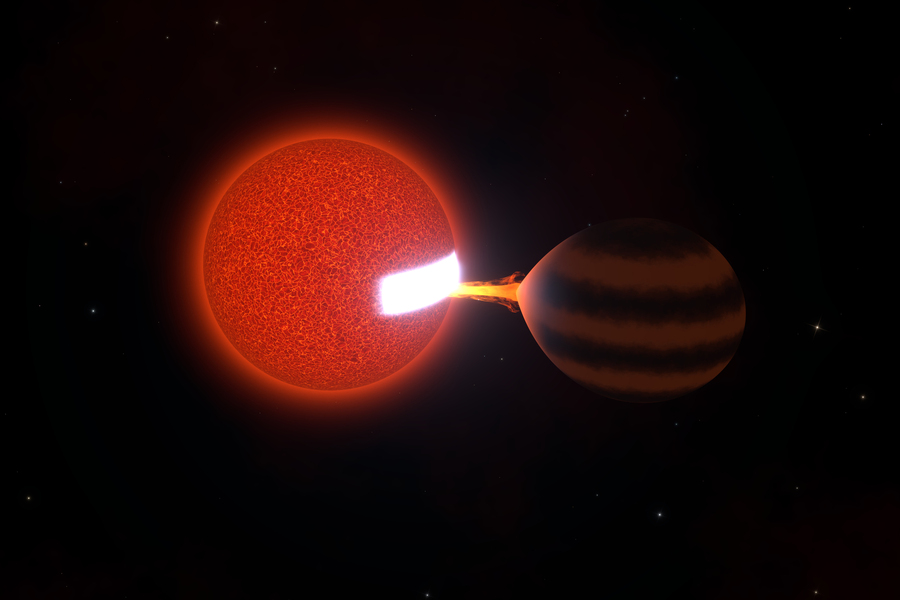
図1. 赤外線星IRAS 16552-3050付近の想像図(Credit: 木下真一郎/鹿児島大学)
<関連情報>
- https://www.nro.nao.ac.jp/p/release/2026-10-06-iras16552-3050/
- https://academic.oup.com/pasj/article-abstract/78/3/1154/8666194
IRAS 16552-3050におけるSiOメーザーのマッピング Mapping the SiO masers in IRAS 16552-3050
Lucero Uscanga, Hiroshi Imai, Kei Amada, José F Gómez, Malcolm D Gray, Tiege P McCarthy, Kitiyanee Asanok, Pablo Santo-Tomás, Daniel Tafoya, Gabor Orosz
Publications of the Astronomical Society of Japan Published:01 May 2026
DOI:https://doi.org/10.1093/pasj/psag051
Abstract
We report observations of SiO (J = 1–0,v=1 , and v=2) maser emission at 43 GHz in IRAS 16552-3050 with the Nobeyama 45 m telescope and the Australia Telescope Compact Array. This is the second water fountain source known to harbor SiO masers. They are located within ~800 au of the dynamical center of the jet traced by H2O masers. The SiO masers present an elongated distribution in the north–south direction with the most blueshifted and redshifted components near the map center. While our absolute astrometric accuracy is modest (≃0.”4), preventing a precise determination of the relative location of the SiO and H2O masers with respect to the central star, both are clearly associated with the same stellar source. Higher angular resolution observations are required to spatially resolve and more precisely locate the individual maser components. Nevertheless, the larger extent of the SiO maser distribution in IRAS 16552-3050 compared to that in W 43A suggests that SiO masers in water fountains may exhibit a diversity of spatial distributions, similar to that observed in H2O masers. We argue that the properties of the H2O and SiO masers are consistent with several plausible scenarios, including a rotating torus, a shared outflow, a compact SiO-emitting region, and a fast bipolar outflow traced by HO masers impacting a slowly expanding AGB shell. Further high-resolution observations are required to test these hypotheses.