2026-10-05 ジョージア工科大学
<関連情報>
- https://news.research.gatech.edu/2026/10/05/new-neural-framework-could-make-llms-more-empathetic
- https://hcai-lab-gt.github.io/capabilibara/
- https://arxiv.org/abs/2606.19625
言語モデルにおける能力の由来:社会的推論に関する事例研究 Capability Provenance in Language Models: A Case Study in Social Reasoning
Glenn Matlin, Chandreyi Chakraborty, Saehee Eom, Mika Okamoto, Rayan Castilla, Louis Jaburi, Alvin Deng, Taywon Min, Lucia Quirke, Stella Biderman, Mark Riedl
arXiv last revised 5 Oct 2026 (this version, v5)
DOI:https://doi.org/10.48550/arXiv.2606.19625
Abstract
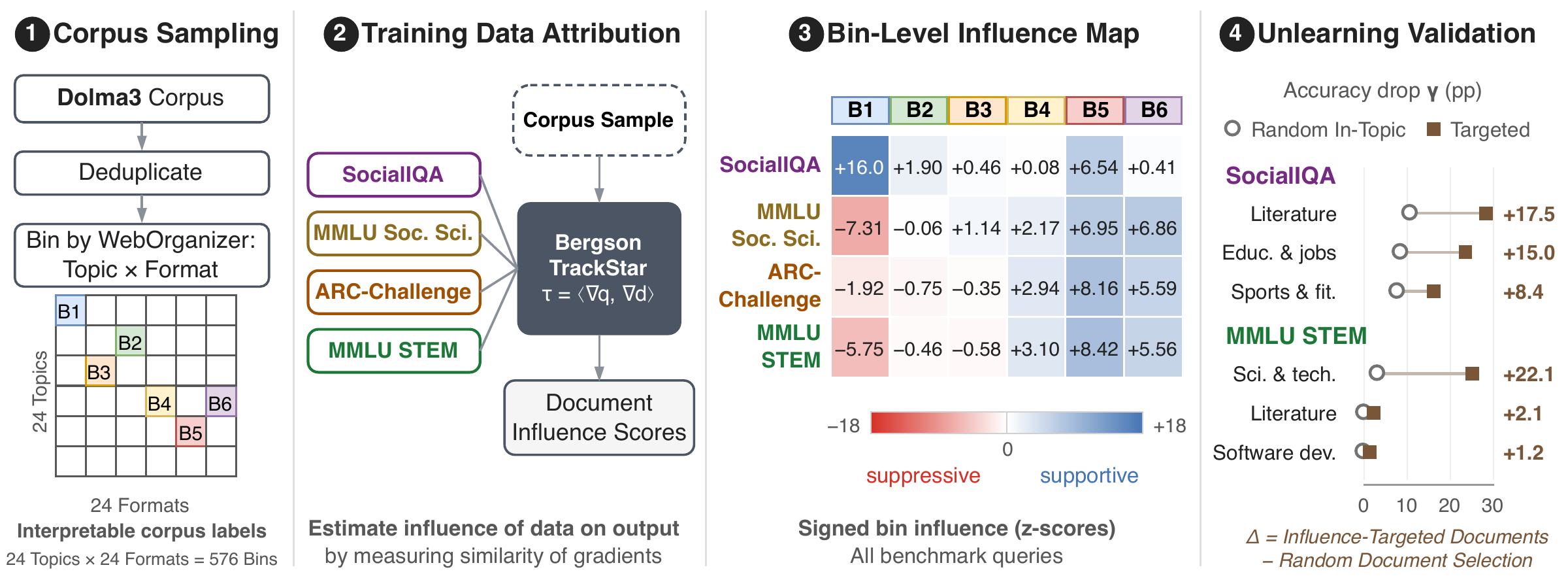
We use training-data attribution as an interpretable tool for capability discovery, mapping which regions of the pretraining corpus support social reasoning versus STEM reasoning in OLMo3-7B. Training-data attribution measures how strongly each training document influences a model’s predictions on a benchmark, but document-level scores are too noisy to identify which corpus regions support which capabilities. We compute gradient-based attribution (TrackStar via Bergson) over a working set drawn from the de-duplicated Dolma3 mix, aggregate influence across WebOrganizer’s 24-format x 24-topic taxonomy (576 bins), and contrast benchmark pairs in a 2×2 design that varies domain (social vs. STEM) and capability type (reasoning vs. knowledge): SocialIQA and MMLU Social Sciences against ARC-Challenge and MMLU STEM. Social and STEM reasoning draw on qualitatively distinct corpus regions, and the contrast is sharper at the reasoning level than at the knowledge level. Targeted machine unlearning provides partial causal validation: forgetting high-attribution topics (e.g., Literature for SocialIQA) degrades the aligned benchmark more than within-topic random baselines. We release the code and aggregate artifacts at this https URL and this https URL.