2026-09-23 カリフォルニア大学リバーサイド校(UCR)
<関連情報>
- https://news.ucr.edu/articles/2026/09/23/making-ai-more-trustworthy
- https://arxiv.org/abs/2604.19974
- https://arxiv.org/pdf/2604.19974
LLMの不確実性と正確性は同じ特徴量で符号化されているのか?スパースオートエンコーダによる機能的分離 Are LLM Uncertainty and Correctness Encoded by the Same Features? A Functional Dissociation via Sparse Autoencoders
Het Patel, Tiejin Chen, Hua Wei, Evangelos E. Papalexakis, Jia Chen
arXiv Submitted on 21 Apr 2026
DOI:https://doi.org/10.48550/arXiv.2604.19974
Abstract
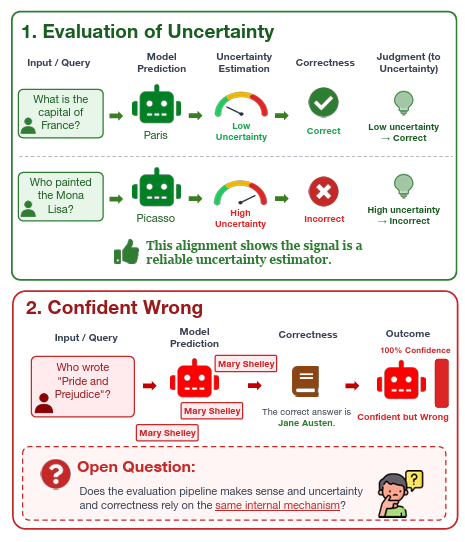
Large language models can be uncertain yet correct, or confident yet wrong, raising the question of whether their output-level uncertainty and their actual correctness are driven by the same internal mechanisms or by distinct feature populations. We introduce a 2×2 framework that partitions model predictions along correctness and confidence axes, and uses sparse autoencoders to identify features associated with each dimension independently. Applying this to Llama-3.1-8B and Gemma-2-9B, we identify three feature populations that play fundamentally different functional roles. Pure uncertainty features are functionally essential: suppressing them severely degrades accuracy. Pure incorrectness features are functionally inert: despite showing statistically significant activation differences between correct and incorrect predictions, the majority produce near-zero change in accuracy when suppressed. Confounded features that encode both signals are detrimental to output quality, and targeted suppression of them yields a 1.1% accuracy improvement and a 75% entropy reduction, with effects transferring across the ARC-Challenge and RACE benchmarks. The feature categories are also informationally distinct: the activations of just 3 confounded features from a single mid-network layer predict model correctness (AUROC ~0.79), enabling selective abstention that raises accuracy from 62% to 81% at 53% coverage. The results demonstrate that uncertainty and correctness are distinct internal phenomena, with implications for interpretability and targeted inference-time intervention.