2026-10-05 東京農工大学大学
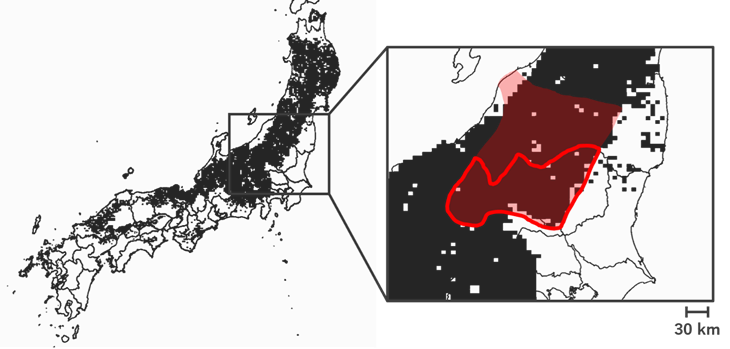
図1:日本におけるツキノワグマの分布域(左の図)と越後・三国個体群の位置図(右の図)。
<関連情報>
- https://www.tuat.ac.jp/outline/disclosure/pressrelease/2026/20261005_01.html
- https://www.sciencedirect.com/science/article/pii/S2351989426002957
駆除の増加は、高齢個体の減少を通じて、アジアクロクマの雌の年齢構成を変化させる Increased culling reshapes the age structure of female Asian black bears through the loss of older age classes
Kahoko Tochigi,Keita Fukasawa, Maximilian L. Allen,Tomoko Anezaki,Misako Kuroe,Tetsuya Maruyama, Koji Yamazaki, Shinsuke Koike
Global Ecology and Conservation Available online: 23 July 2026
DOI:https://doi.org/10.1016/j.gecco.2026.e04345
Abstract
Human–bear conflict in Japan fluctuates markedly among years, often peaking following hard-mast failures that trigger large conflict years (LCYs) that lead to intensified culling. How these spikes reshape population structure remains poorly quantified. We quantified age–structured dynamics of female Asian black bears Ursus thibetanus in central Japan and tested the prediction that conflict-driven culling reshapes age structure by disproportionately removing older females. We implemented a two-step hierarchical framework model, estimating fecundity and natural mortality from independent data as informative priors for an age-at-harvest model fit to 17 years (2001–2017) of harvest records. We contrasted reconstructed population with a counterfactual scenario of low culling across all years and assessed these effects on age-classes. In the reconstructed population, culling probabilities increased with age and plateaued around 6 years old, with LCYs elevating culling similar across all age classes. Total abundance declined slightly (mean population growth rate = 0.984). Compared with a counterfactual scenario without LCY effects, high culling in the reconstructed population reduced the proportion of older age classes (≥7 years old) and increased the proportion of young and intermediate age classes. Absolute number of cubs also declined, although the reduction in the cub proportion appeared temporary rather than permanent. Conflict-driven surges of culling—of the magnitude observed in LCYs—were sufficient to produce detectable demographic shifts via loss of mature females, with co-occurring declines in cub numbers. Adaptive monitoring should therefore track demographic indicators (e.g., proportion of reproductive-age females) and feed these back into quota setting to limit negative population effects.