2026-10-29 東北大学
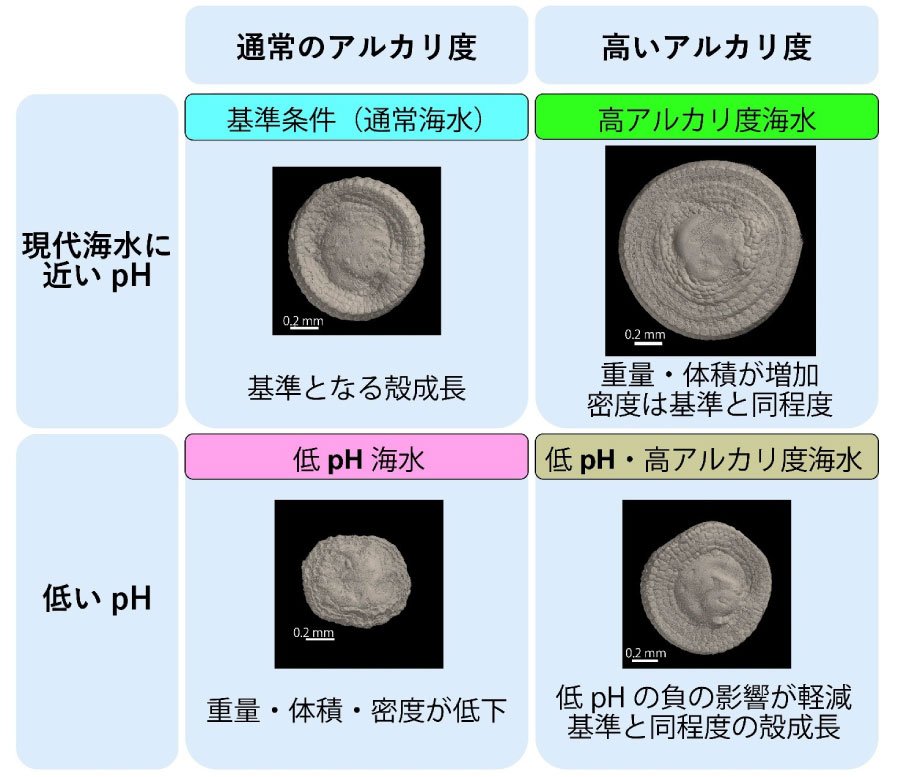
海水のpHとアルカリ度による有孔虫の殻形成の違い
<関連情報>
- https://www.tohoku.ac.jp/japanese/2026/10/press20261029-01-mitigates.html
- https://www.nature.com/articles/s41598-026-74230-y
高アルカリ度は、高CO₂海洋が有孔虫の石灰化の量と質に及ぼす悪影響を緩和する High alkalinity mitigates the negative impacts of high-CO2 ocean on foraminiferal calcification quantity and quality
Shunichi Kinoshita, Azumi Kuroyanagi, Yuri Hashimoto & Atsushi Suzuki
Scientific Reports Published:28 October 2026
DOI:https://doi.org/10.1038/s41598-026-74230-y
Abstract
Ocean acidification threatens marine calcifiers, but the independent effects of seawater pH and total alkalinity on shell formation remain poorly understood. Here, we experimentally decoupled pH and alkalinity to examine their effects on shell growth and density in the large benthic foraminifer Amphisorus kudakajimensis. Low pH under present-day alkalinity substantially reduced shell weight, volume, and density, whereas simultaneously elevated alkalinity largely compensated for these negative effects. Shell weight and volume increased across the tested range of calcite saturation state, consistent with the balance between available inorganic carbon substrates and inhibitory protons. In contrast, shell density showed a more constrained response, suggesting physiological limits on further densification. These results provide experimental support for a carbonate-chemistry mechanism that may help explain how the low-pH but high-saturation conditions of Cretaceous oceans allowed calcifiers to persist. They also suggest that maintaining carbonate saturation through ocean alkalinity enhancement could help protect calcification under future acidification. Assessments of the vulnerability of marine carbonate producers to changing ocean chemistry should therefore distinguish between changes in shell growth and shell density.