2026-06-09 京都大学
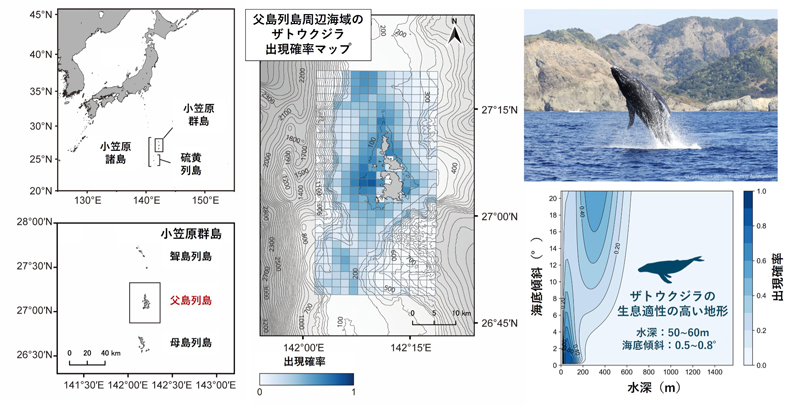
推測された父島列島周辺海域におけるザトウクジラの好適な地形条件と出現確率マップ © Ogasawara Whale Watching Association
<関連情報>
- https://www.kyoto-u.ac.jp/ja/research-news/2026-06-09-0
- https://bioone.org/journals/mammal-study/volume-51/issue-3/ms2025-0036/Predicting-Habitat-Suitability-for-Humpback-Whales-Megaptera-novaeangliae-Around-the/10.3106/ms2025-0036.full
父島諸島および小笠原諸島周辺におけるザトウクジラ(Megaptera novaeangliae)の生息地適性の予測 Predicting Habitat Suitability for Humpback Whales Megaptera novaeangliae Around the Chichijima Islands, Ogasawara Islands, Japan
Koki Tsujii, Ryosuke Okamoto, Hiroto Murase, Yoko Mitani
Mammal Study Published: 18 May 2026
DOI:https://doi.org/10.3106/ms2025-0036
Abstract
The waters around the Chichijima Islands of the Ogasawara Islands, approximately 1000 km south of mainland Japan, are known breeding areas for humpback whales Megaptera novaeangliae, although their suitable habitat in this area has not been assessed in a spatially explicit manner. This study examined the relationship between the spatial distribution of humpback whales and topographic factors, using boat-based sighting survey data from 2013 and 2015–2018. A generalized additive model (GAM) and a maximum entropy model (Maxent) were used to estimate the suitable habitat of humpback whales. Both models demonstrated that the whale distribution was related to water depth and seabed slope, with water depth having a particularly strong influence. High suitability was observed at shallow water depths and gentle slopes, reaching a maximum at depths of 50–60 m and slopes of 0.5–0.8°. Additionally, suitable habitats were more extensive off the west coast than off the east coast, suggesting that the western area was more suitable for whales. The resulting habitat suitability map provides valuable information about their key habitats and can be utilized for their appropriate conservation in this area.