2026-10-28 ブラウン大学
<関連情報>
- https://seas.harvard.edu/news/powering-solar-powered-flight
- https://pubs.acs.org/aelccp/article/11/9/6207/5287335/Powering-the-Persistent-Observation-of-Earth
地球の持続的観測を支える:太陽成層圏航空機向けバッテリー目標 Powering the Persistent Observation of Earth: Battery Targets for Solar Stratospheric Aircraft
Craig A. Mascarenhas; Shashank Sripad; James G. Anderson; Venkatasubramanian Viswanathan; John S. Langford
ACS Energy Letters Published: August 21, 2026
DOI:https://doi.org/10.1021/acsenergylett.6c01616
Abstract
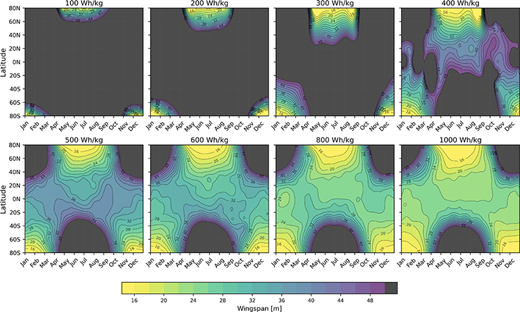
Solar-powered fixed-wing high-altitude long-endurance (HALE) aircraft have the potential to provide persistent atmospheric sensing, communications, and environmental monitoring, but their feasibility is fundamentally governed by onboard energy storage. We quantify the battery performance required for continuous solar-powered HALE flight using a multidisciplinary aircraft optimization framework. Battery cell specific energy is varied from 100 to 1000 Wh kg–1 while evaluating aircraft feasibility, minimum wingspan, payload capability, and geographic operability. A transition from storage-limited to solar-collection-limited operation is identified near 500 Wh kg–1, beyond which gains in geographic feasibility diminish while payload capacity continues to increase. Battery weight fractions are predicted to be 30–40% of takeoff gross weight, while effective charging and discharging rate requirements generally remain below 0.6 and 0.25 h–1, respectively. These results establish quantitative battery performance targets for persistent solar-powered flight.