2026-10-08 中国科学院(CAS)
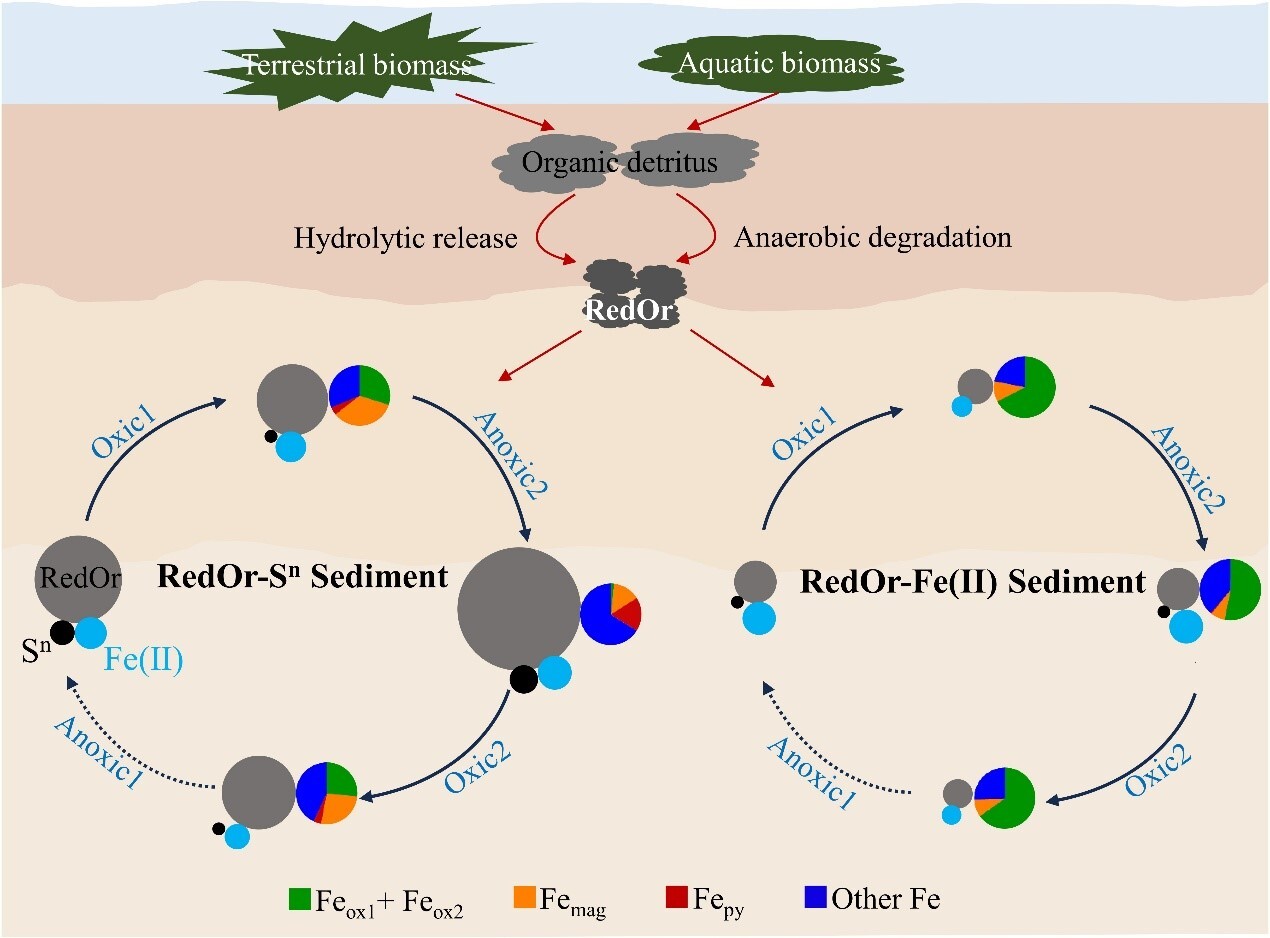
Conceptual model of RC dynamics, component changes, and iron cycling in RedOr-Sn and RedOr-Fe(II) sediments. (Image by IHB)
<関連情報>
- https://english.cas.cn/newsroom/research-news/202610/t20261008_1201779.shtml
- https://pubs.acs.org/esthag/article-abstract/60/32/22454/5250904/Redox-Alternation-Drives-Dynamics-of-Sediment
酸化還元反応の交互作用が堆積物の還元能力の動態を左右する:還元性有機物質の優位性と二価鉄/硫黄の相乗作用 Redox Alternation Drives Dynamics of Sediment Reducing Capacity: Dominance of Reducing Organic Substances and Ferrous-Iron/Sulfur Synergistic Mechanisms
Xuemei Chen;Ruilian Guo;Zhenjun Liu;Yang Jiao;Sen Gu;Qingman Li
Environmental Science & Technology Published:August 10, 2026
DOI:https://doi.org/10.1021/acs.est.5c14069
Abstract
Sediment reducing capacity (RC) regulates benthic habitat function and the biogeochemical cycling of carbon, nutrients, and pollutants. However, the compositional complexity and dynamic responses of RC to redox alternation remain inadequately characterized. Through laboratory stimulation experiments of redox alternation with 20 freshwater sediments from four water bodies with distinct trophic status in China (Honghu Lake: HL, n = 3; Xiashan Reservoir: XR, n = 6; Yudong Reservoir: YR, n = 7; and Zhanghe Reservoir: ZR, n = 4), we monitored the dynamics of RC and its fractions (RCpH7.0, RCpH2.0), and quantified the responses of major reducing components (reducing organic substances (RedOr), Fe(II), and sulfides (Sn, −2 ≤ n < 0)). Redox alternation triggered asynchronous RC responses, with depletion during oxic phases and recovery under anoxia. RC fluctuation amplitude exhibited sediment-type dependence, with RedOr-Sn sediments (HL/XR) showing greater variability than RedOr-Fe(II) systems (YR/ZR). Component-specific contributions differed significantly between sediment types (p < 0.05). RedOr contributed most to RC variation in RedOr-Sn sediments (45.9–71.2% vs 35.7–52.2% in RedOr-Fe(II)), whereas Fe(II) contributed 45.8–61.5% in RedOr-Fe(II) sediments (18.9–26.6% in RedOr-Sn), and Sn accounted for 8.73–27.5% in RedOr-Sn sediments (1.62–2.62% in RedOr-Fe(II)). These differences reflected anoxia-driven differences in component reactivity and abundance. RedOr-Sn sediments exhibited concurrent enrichment of RedOr, Fe(II), and Sn, whereas RedOr-Fe(II) sediments showed mainly enhanced Fe(II) reactivity with limited RedOr/Sn changes. Mechanistically, the observed RC patterns were consistent with distinct Fe cycling pathways. In RedOr-Sn sediments, limited labile Fe(III) was associated with greater apparent involvement of magnetite, whereas easily reducible/reducible Fe(III) fractions were more prominent in RedOr-Fe(II) systems. Our findings demonstrate the high lability of eutrophic sediment RC and establish redox alternation as an efficient diagnostic tool for identifying reductive sediment types and pinpointing regulatory targets.