2026-09-14 中国科学院(CAS)
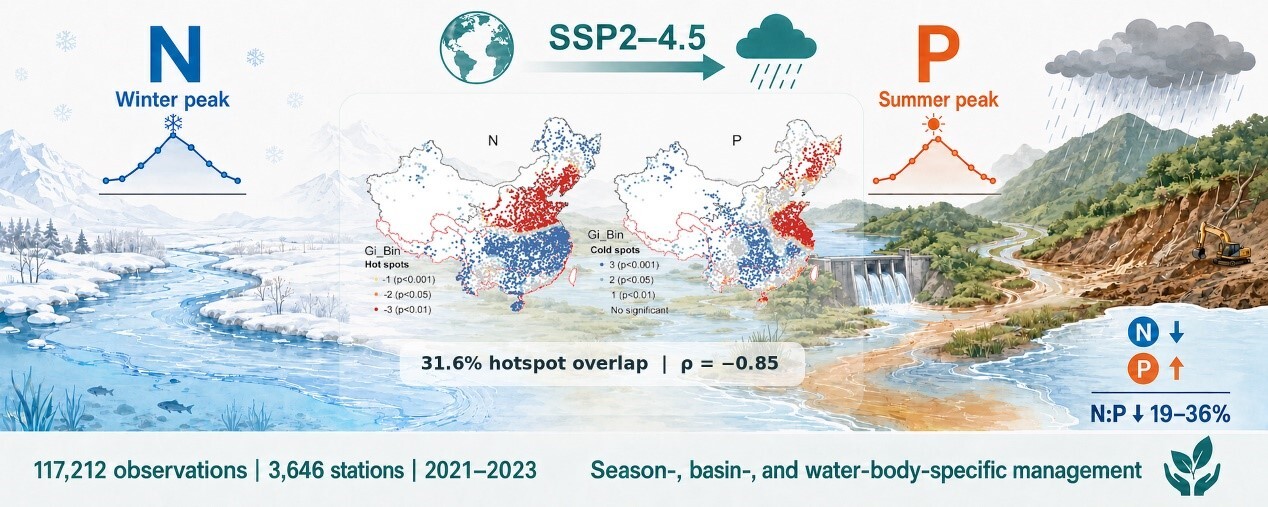
Climate shifts decouple nitrogen and phosphorus redistribution patterns in China’s inland waters, calling for season‑, basin‑ and water‑body‑specific nutrient management. (Image by IHB)
<関連情報>
- https://english.cas.cn/newsroom/research-news/202609/t20260914_1200445.shtml
- https://www.sciencedirect.com/science/article/abs/pii/S0013935126018360
気候変動により、中国内陸水域における窒素とリンの再分配パターンが分断される Climate shifts decouple nitrogen and phosphorus redistribution patterns in China’s inland waters
Yuan Li, Peter B. Reich, Cheyenne Lei, Anna M. Michalak, Li Li, Mohammed Ombadi, Qiusheng He, Kai Zhu, Yonghong Bi
Environmental Research Available online: 17 August 2026
DOI:https://doi.org/10.1016/j.envres.2026.125505
Highlights
- N and P show contrasting spatial patterns across China’s inland waters.
- Nutrient levels and climate responses vary markedly among water-body types.
- N peaks in winter, whereas P peaks in summer.
- SSP2-4.5 climate shifts are projected to decrease N but increase P.
- N–P divergence calls for seasonal and water-body-specific management.
Abstract
Nutrient dynamics in inland waters are shaped by climate change, yet how climate shifts reorganize nitrogen (N) and phosphorus (P) distributions across waters remains poorly resolved. Here, a dataset encompassing 117,212 validation grade monthly observations captured across 3646 unique monitoring stations from January 2021 to December 2023, combined with geostatistical mapping and climate–nutrient models, was used to assess seasonal nutrient patterns across China’s rivers, reservoirs, lakes, and estuaries to project their responses under mid- and late-century SSP2-4.5 climate scenarios. Results showed the mean N and P concentrations were 2.57 ± 2.66 mg L−1 and 71 ± 66 μg L−1 respectively, with strong varying among water-body types; estuaries had the highest mean concentrations of both N and P, whereas lakes had the lowest Nand reservoirs had the lowest P. Moreover, N concentrations were higher in winter than in summer, whereas P concentrations peaked in summer. Across paired monitoring sites, the median molar N:P ratio was 53% higher in winter than in summer, and national monthly mean N and P concentrations were strongly inversely correlated (ρ = −0.85). Extreme spatial hotspots were also distinct: only 31.6% of the sites in the upper decile of N concentrations were simultaneously in the upper decile of P concentrations. Under SSP2-4.5, projected decreases in N and increases in P reduced seasonal molar N:P ratios by approximately 19–36% by the mid- and late-century periods. These temporal, spatial, and stoichiometric metrics demonstrated that climate-conditioned N–P decoupling reflects divergent redistribution patterns rather than merely opposite mean concentration trends. It was deduced that regionally differentiated management strategies rather than uniform national nutrient targets control strategies were required in the future.