2026-10-07 量子科学技術研究開発機構,千葉大学,東京科学大学,京都大学,株式会社Type-I Technologies
<関連情報>
- https://www.qst.go.jp/site/press/20261007.html
- https://pubs.acs.org/anaccx/article/doi/10.1021/acsnanoscienceau.6c00068/5444935/Spin-Uniform-Nanodiamond-Quantum-Sensors-for
再現性のある細胞内温度測定のためのスピン均一ナノダイヤモンド量子センサー Spin-Uniform Nanodiamond Quantum Sensors for Reproducible Intracellular Thermometry
Chihiro Suzuki;Tamami Yanagi;Risa Ujiie;Masanori Fujiwara;Izuru Ohki;Hiroshi Abe;Shinobu Onoda;Takeshi Ohshima;Norikazu Mizuochi;Kiichi Kaminaga;Ryuji Igarashi
ACS Nanoscience Au Published:October 06, 2026
DOI:https://doi.org/10.1021/acsnanoscienceau.6c00068
Abstract
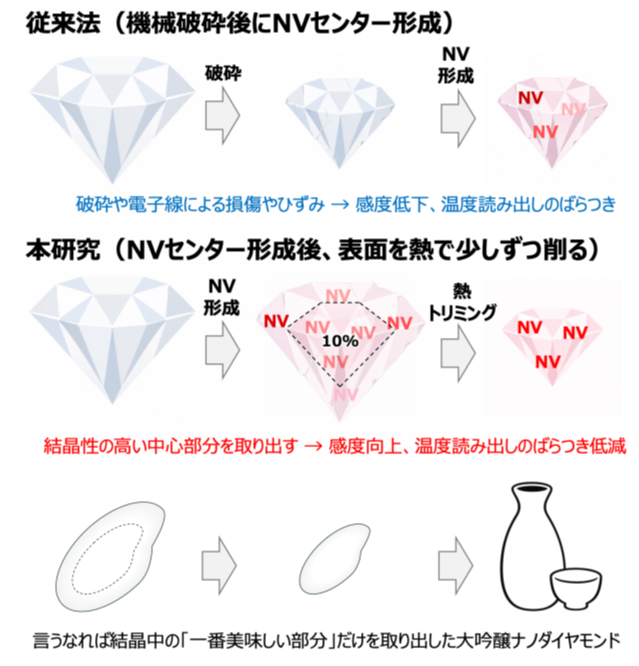
Nanodiamond quantum sensors have been regarded as promising probes for cellular thermometry, but their poor sensor-to-sensor reproducibility has hindered practical implementation. In cellular measurements, the resulting temperature-readout offsets can be mistaken for real cell-to-cell temperature differences, limiting quantitative comparison. Here, we show that spin-uniform nitrogen vacancy (NV)-rich nanodiamonds can be produced via postenrichment oxidative size reduction, which removes defective surface layers while improving crystallinity. Compared with nanodiamonds prepared by conventional mechanical milling before NV enrichment, the particle-to-particle spread in the temperature-sensitive D values was reduced by 3.7-fold. The improved NV homogeneity also enhanced spin properties: the optically detected magnetic resonance contrast─a key signal amplitude for sensitivity─increased by more than 50%. Together, these improvements reduce cell-to-cell dispersion in D-derived single-cell temperature readouts to below 0.7 K, enabling reliable temperature comparison across cells. This approach advances nanodiamond absolute thermometry toward organelle-scale intracellular temperature mapping and practical quantum sensing in biology and medicine.