2026-09-17 コンコルディア大学
<関連情報>
- https://www.concordia.ca/cunews/artsci/2026/09/17/research-new-doping-method-could-boost-the-performance-of-organic-semiconductors.html
- https://www.nature.com/articles/s41563-026-02717-0
ルイス酸によって促進される有機半導体の劣化補助ドーピング Degradation-assisted doping of organic semiconductors enabled by Lewis acids
Melissa Berteau-Rainville, Taylor P. L. Cosby, Shubham Bhagat, Amy E. Laturski, Myles Creran, Zuchong Yang, Emanuele Orgiu, Thomas Baumgartner, Christopher B. Caputo & Ingo Salzmann
Nature Materials Published:14 August 2026
DOI:https://doi.org/10.1038/s41563-026-02717-0
Abstract
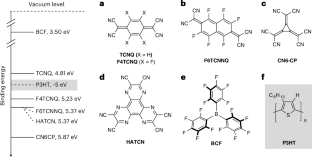
The chemical doping of organic semiconductors with molecular dopants is crucial for high-performance organic electronic devices. Chemically stable dopants are commonly used, enabling electron transfer until a thermodynamic equilibrium is reached, which then terminates the doping process. Here we demonstrate that using p-dopants that chemically degrade after electron transfer via their radical anion can increase the hole densities in the semiconductor host by up to two orders of magnitude. In this degradation-assisted doping mechanism, the electron affinity of the doping agent only enables a limited amount of charge transfer. Subsequent dopant degradation effectively removes its products from co-defining the thermodynamic equilibrium and, thus, allows the doping reaction to persist. We demonstrate that the prototypical Lewis acid tris(pentafluorophenyl)borane (B(C6F5)3) exemplifies degradation-assisted doping, and provide the theoretical framework for this doping strategy offering new avenues for optimizing charge carrier densities in organic semiconductors.