2026-07-16 愛媛大学
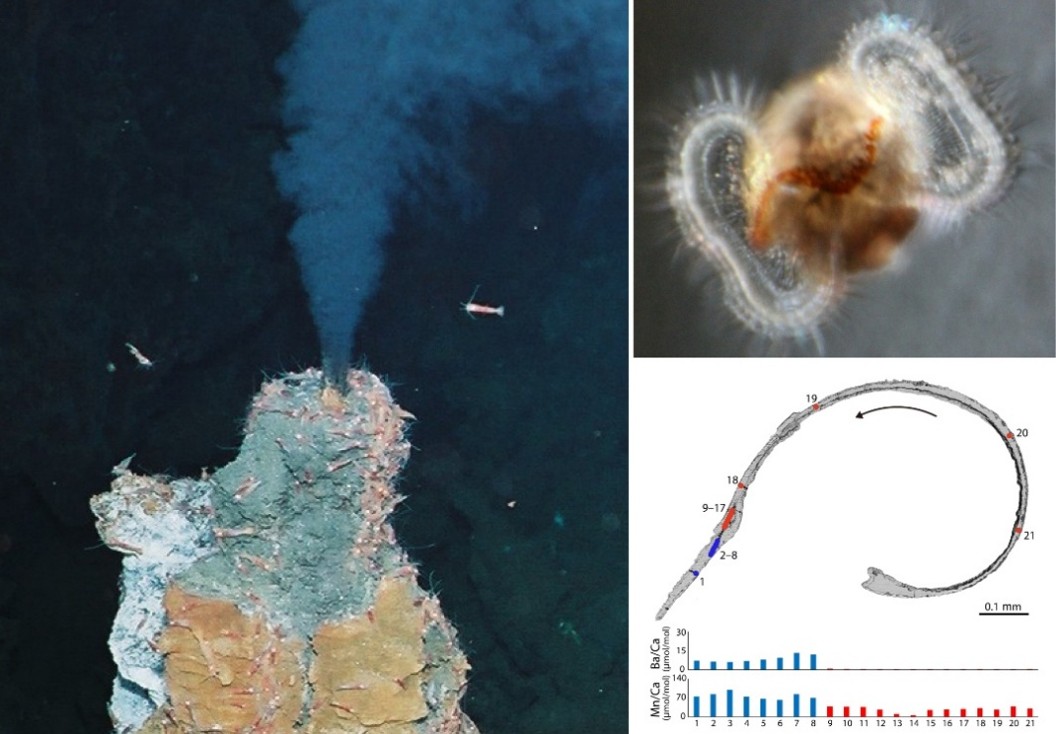
特殊なエビや貝類が生息する深海の温泉
(水深1,920m、南太平洋ラウ海盆 ©JAMSTEC):貝殻分析により小さな幼生の壮大な旅路を解き明かす
<関連情報>
- https://www.ehime-u.ac.jp/data_relese/pr_20260716_agr/
- https://www.science.org/doi/10.1126/sciadv.adx7045
腹足類の殻には、深海の熱水噴出孔から有光層への幼生の移動の記録が残されている Gastropod shells record larval migration from deep-sea hydrothermal vents to the euphotic zone
Takuya Yahagi, Kentrao Tanaka, Tomihiko Higuchi, Kotaro Shirai, […] , and Yasunori Kano
Science Advances Published:15 Jul 2026
DOI:https://doi.org/10.1126/sciadv.adx7045
Abstract
Larval migration plays an essential role in determining the distribution and evolution of invertebrate animals endemic to hydrothermal vents—disjunct and ephemeral habitats in the deep sea. However, technical obstacles have prevented field observation or tracking of their free-swimming, microscopic larvae. Our geochemical analyses of pre- and postmetamorphic parts of shells revealed that the plankton-feeding (planktotrophic) larvae of vent-endemic limpets migrate to the upper layers, in or near the euphotic zone (0 to 200 m). Oxygen isotopes indicated that the larvae experienced warm temperatures approximating conditions in the euphotic zone above the vent sites, whereas barium and manganese concentrations as proxies for hot vent fluids were much higher in postmetamorphic than in premetamorphic shells, dismissing retention under hydrothermal influence. Our results provide evidence for the influence of surface currents and temperature on the distributions of chemosynthetically nourished vent communities in the deep sea. These findings also contribute to modeling deep-sea ecosystem connectivity and planning protected areas.