2026-07-07 分子科学研究所
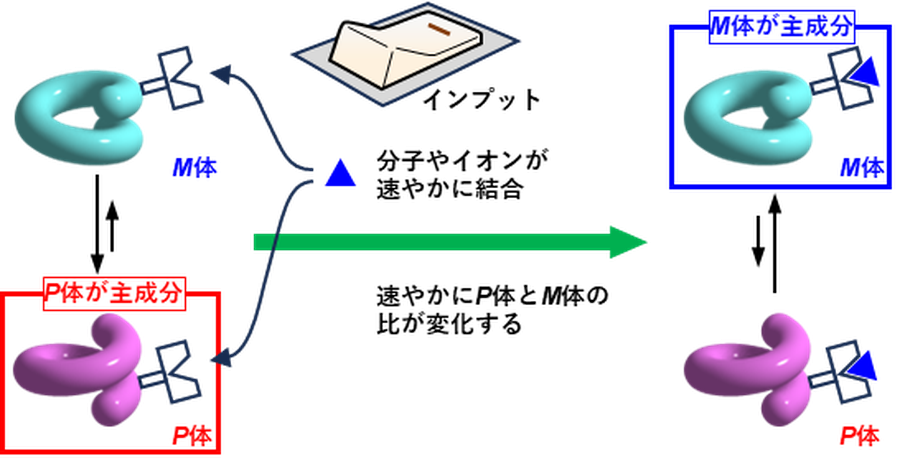
図1 一般的なゲスト結合を「インプット」とした右巻き(P体)・左巻き(M体)の反転。ゲスト分子やイオンが速やかに結合し、それと同時に瞬時に左右反転が起こっているように観測される。途中の過程を明らかにするのは困難であり、あまり解明されてこなかった。
<関連情報>
閉じたカゴ構造を持つ三重らせん型メタロクリプタンドにおける遅いキラリティー反転と遅いゲスト取り込みの連動機構 Interplay between Slow Chirality Inversion and Slow Guest Uptake in a Triple-Helical Closed-Cage Metallocryptand
Sk Asif Ikbal,Masahiro Ehara,and Shigehisa Akine
Journal of the American Chemical Society Published June: 29, 2026
DOI:https://doi.org/10.1021/jacs.6c09090
Abstract
Intelligent responsive materials are important components for molecular machines and memory devices. However, the mechanism of guest-induced chirality inversion remains elusive because guest binding is typically too fast to resolve the process. To address this challenge, it is necessary to develop a system in which chirality inversion and guest uptake occur on comparable, slow time scales. Here, we report a triple-helical closed-cage cobalt(III) metallocryptand incorporating three bridging 1,7-heptanediamine (hpda) ligands, which creates a closed-cage architecture that significantly slows guest uptake/release. X-ray crystallography revealed the formation of a (P,R6) diastereomer with a right-handed triple-helical structure. In solution, a dynamic equilibrium between the (P,R6) and (M,R6) diastereomers was observed with slow interconversion (t1/2(app) = 20 min). Upon addition of CsCl, the P/M chirality was gradually inverted from a P-abundant state to an M-abundant state over several hours, associated with slow Cs+ uptake. The closed-cage design with bridging hpda ligands significantly slowed both Cs+ uptake and P/M interconversion, allowing the two processes to proceed on comparable, slow time scales. Kinetic analysis based on a four-species reversible model revealed that Cs+ is preferentially taken up in the less abundant M form, whereas P form does not directly bind Cs+ but instead contributes to uptake after P→M isomerization. The M form binds Cs+ more strongly than the P form, thus driving the P→M chirality inversion through this M-form-mediated pathway. In contrast, addition of Cl– shifted the equilibrium toward the more P-favored mixture by interacting with Cl– at the peripheral binding pocket, highlighting its opposite stereodynamic effect relative to Cs+. These findings demonstrate that cage closure modulates both the timing and sequence of events during the pathway of guest-induced chirality inversion, and provide a kinetic platform for probing guest effects on stereodynamic equilibria. We also anticipate that the strategies used here can be applied to the rational design of other smart molecular architectures.