2026-07-07 東京科学大学
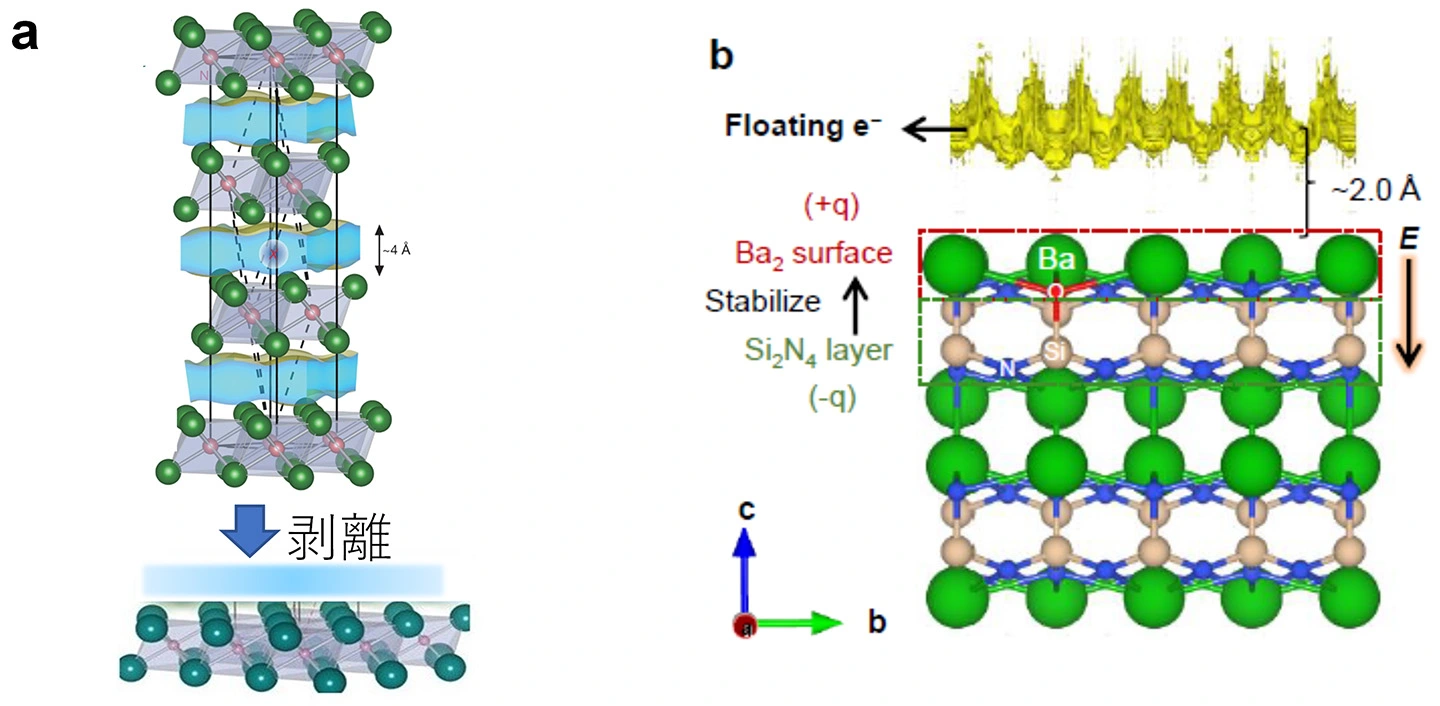
図1. (a)層間に電子が存在する2次元エレクトライドから剥離する方法 (b)今回実現したBaSiN2結晶への電子ドープにより生成した表面エレクトレン
<関連情報>
空気中で安定な表面エレクトレンの作製とそのアンモニア合成への応用 Creation of an air-stable surface electrene and its application to ammonia synthesis
Zhujun Zhang,Shiyao Wang,Jiang Li,Masato Sasase,Masaaki Kitano & Hideo Hosono
Nature Communications Published:23 June 2026
DOI:https://doi.org/10.1038/s41467-026-74820-4 Unedited version
Abstract
Electrenes are unique materials characterized by a surface floating electron layer, which results in an ultra-low work function, making them ideal candidates for catalyzing chemical reactions via electron donation. However, these materials are extremely sensitive to air and moisture, thereby limiting their potential applications. Here, we demonstrate that oxygen-doped BaSiN2 is an air-stable surface electrene. Its highly active surface, with an ultra-low WF of approximately 1.5 eV, can donate surface floating electrons to adsorbed N2, forming an N2-passivated surface, which can be constantly regenerated through hydrogenation of surface-activated N2. This alternating pathway, particularly with the assistance of Ru loading, effectively produce ammonia: the Ru/BaSiN2:O catalyst exhibits high ammonia synthesis rate of 43 mmol gcat−1 h−1 at 300 °C and 0.9 MPa, and much superior air stability compared to the most active electrides and hydrides-based heterogeneous catalysts reported to date. This discovery opens a new way for electrene-driven heterogeneous catalysis.